English courses for children aged 4-5
Why early English learning matters
Children aged 4-5 naturally learn through listening, imitation and play, making early English highly effective. It also builds memory, attention, creativity and confidence.

Why 4-5 is a great age to start English

Perfect pronunciation develops naturally
No fear of making mistakes
Language patterns absorbed through play
Builds cognitive flexibility


Early bilingualism is associated with developmental advantages in non-verbal tasks requiring cognitive flexibility.


How we teach children aged 4-5
Total Physical Response (TPR)
Our teachers use gestures, facial expressions and movements to convey meaning. Children understand and learn through action naturally.

Language immersion
Our certified teachers speak only English during lessons, but children understand through visual aids, props, demonstrations and games. This mirrors how children learn their first language.

Play-based Learning
Every activity feels like a game. Each lesson includes interactive games, songs, storytelling and visual activities suited for kids aged 4-5. Learning happens naturally through play, not memorization.

Friendly teachers
Lessons take place in a secure, colourful virtual classroom with a native-speaking teacher who guides children with attention and patience, ensuring every child feels comfortable and engaged.


At ages 4-5, children are naturally curious and flexible. Novakid English lessons build on that by switching between fun topics and languages, so they practice thinking in more than one way.
Your child’s results after completing the course
Greets people and introduces themselves
Names colours, shapes and family members
Shows enthusiasm and confidence with English

Lesson structure
This approach keeps motivation high and makes learning English natural and engaging for preschoolers
~5 minutes
Playful warm-up
Fun activities to energize and prepare for learning – songs, greetings, quick games
25 minutes
A 1-on-1 lesson with a teacher
One-on-one interactive session with your certified native teacher, including games, stories and vocabulary practice
~10 minutes
Fun homework
Engaging activities children love. Interactive games, puzzles and challenges that reinforce what they learned
Course structure
You'll notice your child's progress just a few weeks after starting the course
Course duration
67 lessons (25 minutes each)Recommended frequency
2 lessons/week (~8 months)Course level
Novakid: Pre-K level CEFR: Pre-A1. Suitable for non-readers.
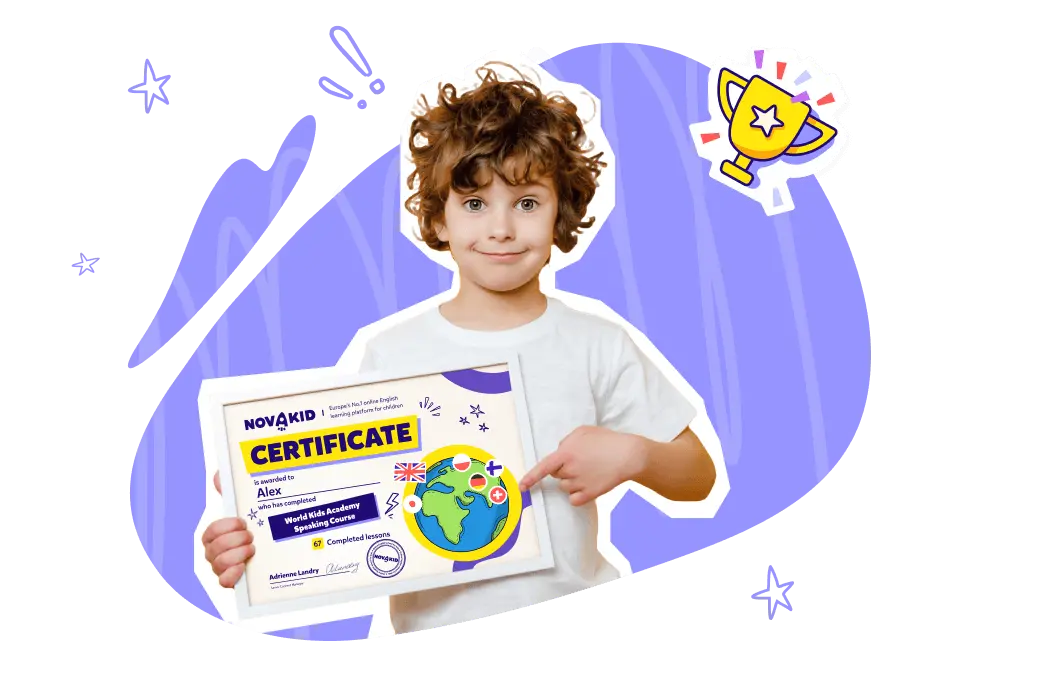
Certificate of completion
After the course, your child receives a certificate showing their Novakid level and the corresponding CEFR level achieved.
What's included in our course for children aged 4-5
 Certified teachers with experience in preschool education (TEFL, TESOL, CELTA certified)
 Unlimited interactive homework (games, songs, activities)
International group practice
1 month free! Engaging virtual classroom with colourful visuals, interactive materials and age-appropriate tools
 CEFR-aligned curriculum (Pre-A1 level, suitable for non-readers)
 Parent access to progress tracking, lesson materials and detailed teacher feedback

Start with a free trial lesson
We'll assess your child's learning needs and provide you with a personalized report showing the recommended starting point and learning path
Book a free lesson

Questions and answers
Is my 4-year-old too young to learn English online?
Not at all! Our lessons are specifically designed for preschoolers. Activities change every 3-5 minutes to match attention spans, and everything feels like play.
Does my child need to know how to read?
No! Our courses for children 4 years old are designed for non-readers. Learning happens through listening, speaking and visual aids – just like with their first language.
What if my child is shy or doesn't want to participate at first?
This is completely normal. Our teachers are trained to gently encourage participation without pressure. Most children open up by the second or third lesson.
How quickly will I see results?
Most parents notice their child using simple English words and phrases within the first month. Consistent practice (2-3 lessons weekly) yields the best results.
What will my child achieve by the end?
By the end of the course, children can use 290+ English words, greet and introduce themselves, name colours, shapes and family members, count to 10 and respond to simple questions. They complete Pre-A1 (Level Pre-K) and are ready for the next level.
What does 'CEFR-based' mean for preschoolers?
It means your child follows a clear step-by-step path to Pre-A1, but learns through games, songs and speaking – not reading or grammar. The programme is fully adapted for non-readers aged 4-5.
How do you keep a child engaged online if they can't sit still?
Activities change every 3–5 minutes and include movement, songs, interactive games and rewards. This matches preschool attention spans and makes learning feel like play.
Is it 100% English from the start (full immersion), and what if my child doesn't understand?
Yes – our teachers speak only English and use gestures, props, visuals and actions (TPR) so children understand naturally without translation. This is how kids learn to speak confidently from the very first lessons.
Can I choose (or change) the teacher if the match isn't great?
Yes. You can choose a teacher with experience teaching young learners and change anytime. The right teacher will help your child feel comfortable and start speaking faster.
How long are the lessons and how many times per week is best for this age?
Each lesson is 25 minutes, which is ideal for preschoolers. For the best results, we recommend 2–3 lessons per week.
Should a parent sit next to the child during the lessons?
At the beginning, it helps to stay nearby for support. After a few lessons, most children confidently join on their own and interact directly with the teacher.