



Discover how AI is transforming English learning. Explore the benefits of 24/7 tutoring, the risks of cognitive atrophy, and the future of education.



Parents wondering if is English easy to learn probably deserve something more useful than a cheerful “Yes!”.
English gave us “though”, “through” and “thought”, then apparently went out for lunch before anyone could request consistency. Calling learning English effortless requires a certain generosity of spirit.
But whether is English an easy language to learn is also an enormous question. Easy to order a sandwich? Follow a story? Explain why your sister absolutely started it?
Those are different jobs. A language can feel manageable in one situation and unexpectedly demanding in another.
To investigate what might make the process more manageable for children, we looked at Novakid’s survey of 347 English teachers alongside research on language learning and memory. Drawing on the survey responses and research, we propose the following formula:
English learning = Exposure × Use × Consistency
The multiplier: ownership.
No researcher has assigned a numerical value to a child negotiating an extra biscuit in English using this formula. The multiplication sign simply highlights the connections between the ingredients.
But let’s discuss it:

Questions such as why English is easy often focus on the language itself. The formula also considers the opportunities a child has to encounter English in familiar situations, with support from the people around them.
In the Novakid teacher survey, respondents recommended integrating English into routine activities. When asked about the most common mistake parents make at home, one teacher wrote: “The single most common mistake is turning English practice into a test instead of making it part of everyday life.”
Another respondent offered concrete examples: “At home, I believe parents can focus more on creating simple, natural opportunities to use English, like talking about toys, food, or their daily routine.” These are situations in which the topic is already familiar to the child.
Support can also come from parents who do not speak English themselves. One teacher explained: “I encourage them to create an English-friendly environment by watching cartoons together, listening to English songs in the car, or simply asking their child to “teach” them the words they learned in our lesson.”
These recommendations illustrate meaningful exposure: English connected to familiar activities, shared experiences and opportunities to participate.
Recognizing a word and recalling it independently involve different tasks. A child may identify a fox on a labeled flashcard, then need more support to remember “fox” when describing a story without the card.
For parents asking how easy English is to learn, this distinction helps clarify what a child is practicing: recognizing an answer, recalling it or using it to communicate.
In a 2008 experiment, Jeffrey Karpicke and Henry Roediger studied university students learning foreign-language vocabulary. After a word had been recalled correctly, further retrieval practice improved delayed recall. Further studying alone did not produce the same benefit.
This research involved university students learning vocabulary pairs. It did not test conversation lessons for children. It nevertheless provides evidence for distinguishing between repeated exposure to an answer and practicing recalling it.
In the Novakid survey, 43.8% of teachers gave flashcards a score of five for new vocabulary learning (149 of 340 respondents), while 40.0% gave real conversation practice that score (138 of 345).
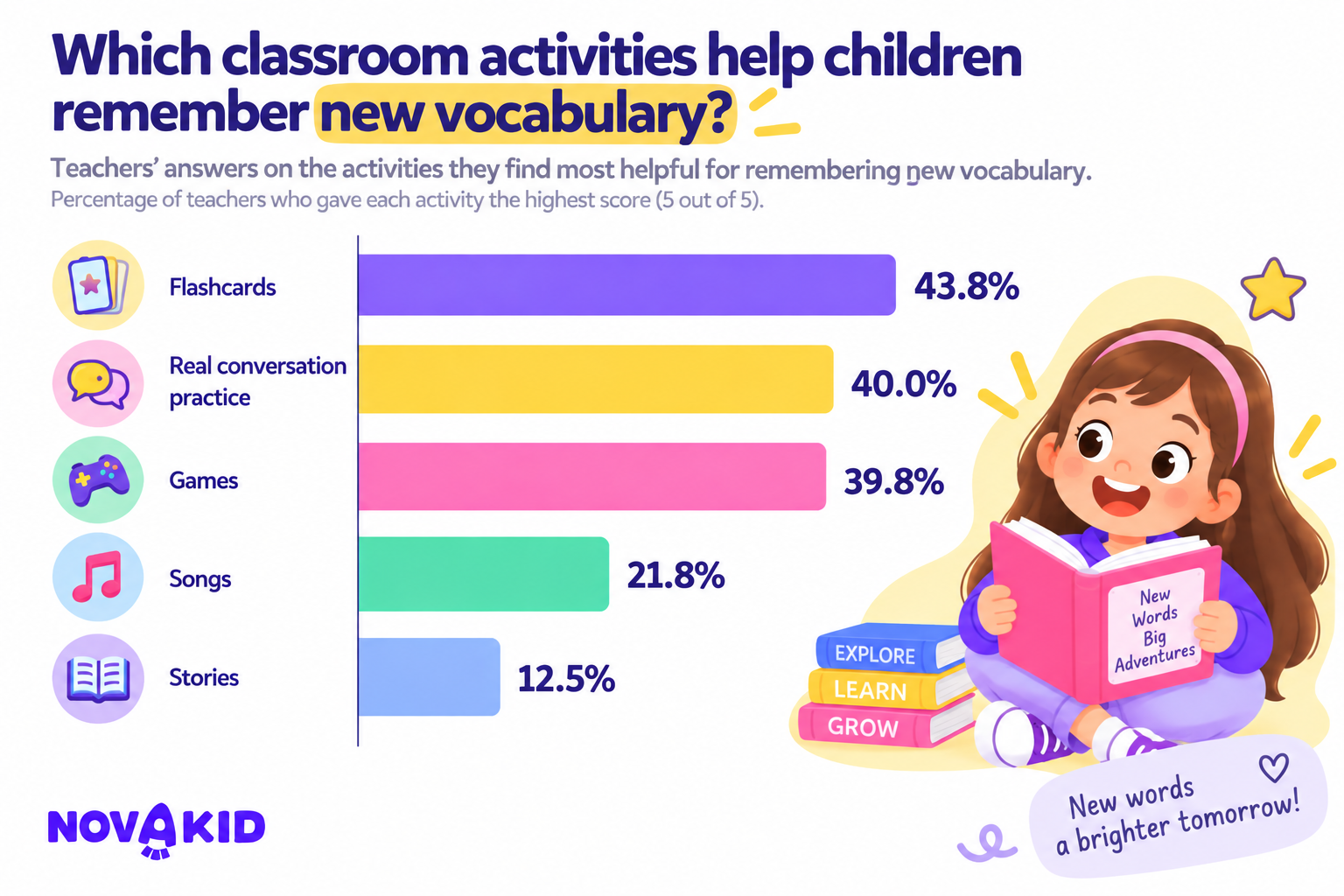
Activities can serve complementary purposes. A picture can introduce a word, a question can invite the child to recall it, and a conversation can provide a reason to use it.
When considering is it easy to learn English, parents can also ask whether their child has regular opportunities to produce their own responses.

Some English teachers in the survey reported that parents ask why lessons repeat topics or vocabulary. These responses raise a useful question: what does repetition contribute to learning?
Nel de Jong and Charles Perfetti studied 24 ESL students practicing speeches. Both groups improved fluency during training, but only the students who repeated their speeches maintained their improvements on subsequent tests.
The study was small and did not establish a practice routine for young children. Its findings suggest that revisiting a speaking task can contribute to lasting improvement under the conditions tested.
The interval between learning sessions also matters. Another study of 52 Cantonese-speaking primary pupils learning 20 English adjectives found that on a multiple-choice test four weeks later, pupils performed better on words revisited after one day than on words revisited after eight days.
Both schedules involved spaced practice. The findings show a difference between the two intervals in that setting; they do not establish a single ideal schedule for every learner.
For our formula, consistency means returning to familiar language regularly and adjusting the practice to the child’s needs. A word introduced in a lesson could be recalled in a short activity and used again in a later conversation.
In the survey, 71.3% of teachers answering the home-practice question selected between 15 and 60 additional minutes per week (246 of 345): 38.6% chose 15–30 minutes, and 32.8% chose 30–60 minutes. These were teachers’ estimates of practice beyond class, rather than experimentally established requirements.
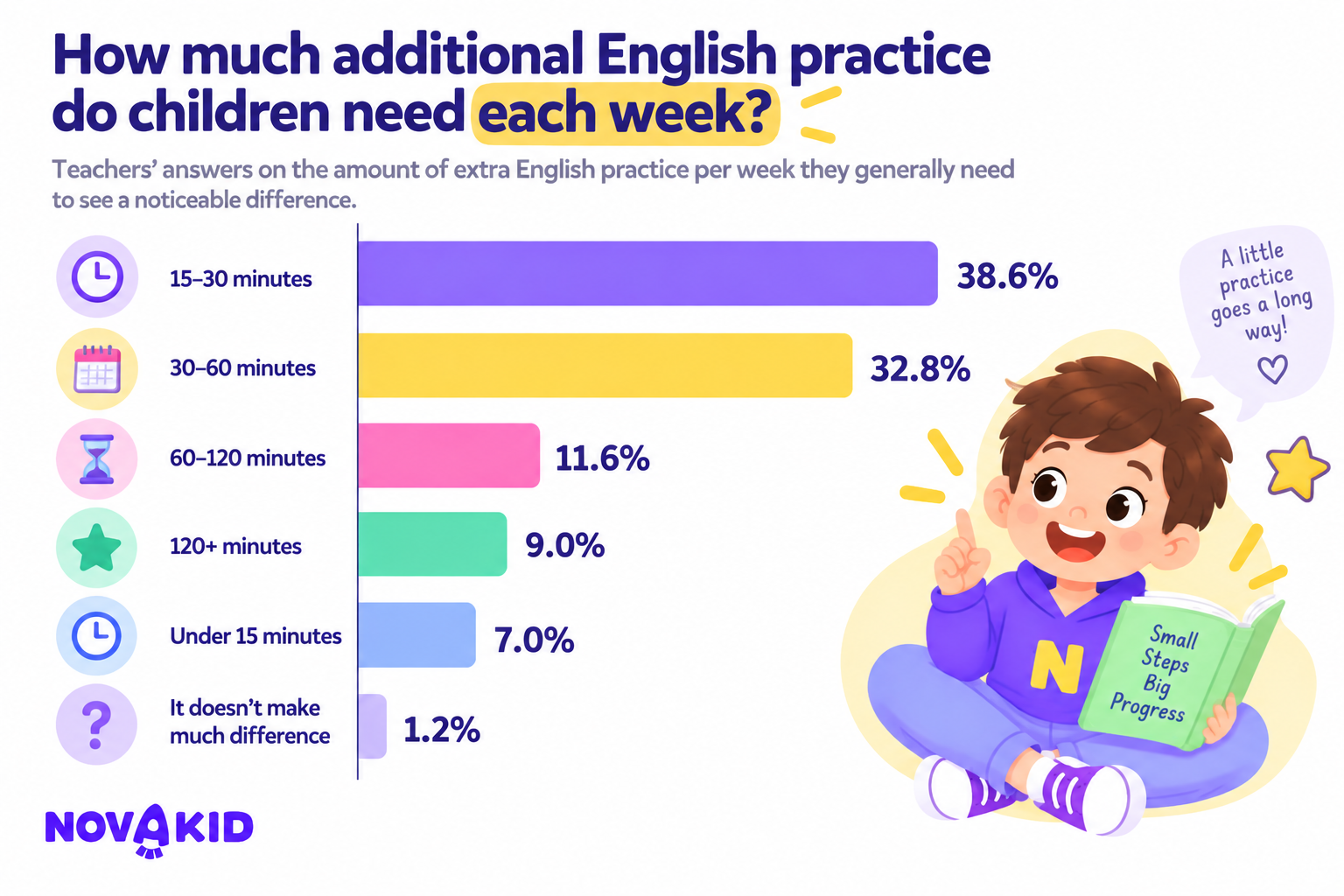
Questions such as how easy is it to learn English are therefore useful starting points for discussing the learner’s routine.
Ownership means giving the child a supported opportunity to think, recall and respond.
Consider this illustrative exchange:
“What did you do yesterday?”
Child: “I…”
Parent: “Went swimming! Tell her you went swimming!”
The parent has supplied the answer before the child could complete it independently. Teachers in the Novakid survey described this situation directly. One respondent wrote: “Parents help their children answer the questions by giving them the answers directly instead of allowing them to think and respond independently.”
Another teacher acknowledged the intention behind this intervention: “Sometimes they want to help, but the child needs time to think and respond independently.”
These observations inform the ownership component of the proposed formula: giving children room to attempt an answer while keeping support available. This might mean a clue, a simpler question or a choice between two options, followed by another opportunity to answer.
Allowing that first attempt also gives the teacher useful information. As one respondent explained: “This allows the teacher to identify areas that need practice and guide the student accordingly.”
Parents can also discuss with the teacher what the child managed independently and where support was needed. This provides context for a completed worksheet or an app score.
In the survey, the majority of teachers selected a positive effect of AI practice tools on speaking confidence: 54.5% chose “Helps a little”, and 18.7% chose “Helps a lot” (243 of 346 combined). Meanwhile, 12.3% selected “No noticeable effect”, and 8.1% selected a negative effect. The remaining responses included uncertainty and written qualifications.
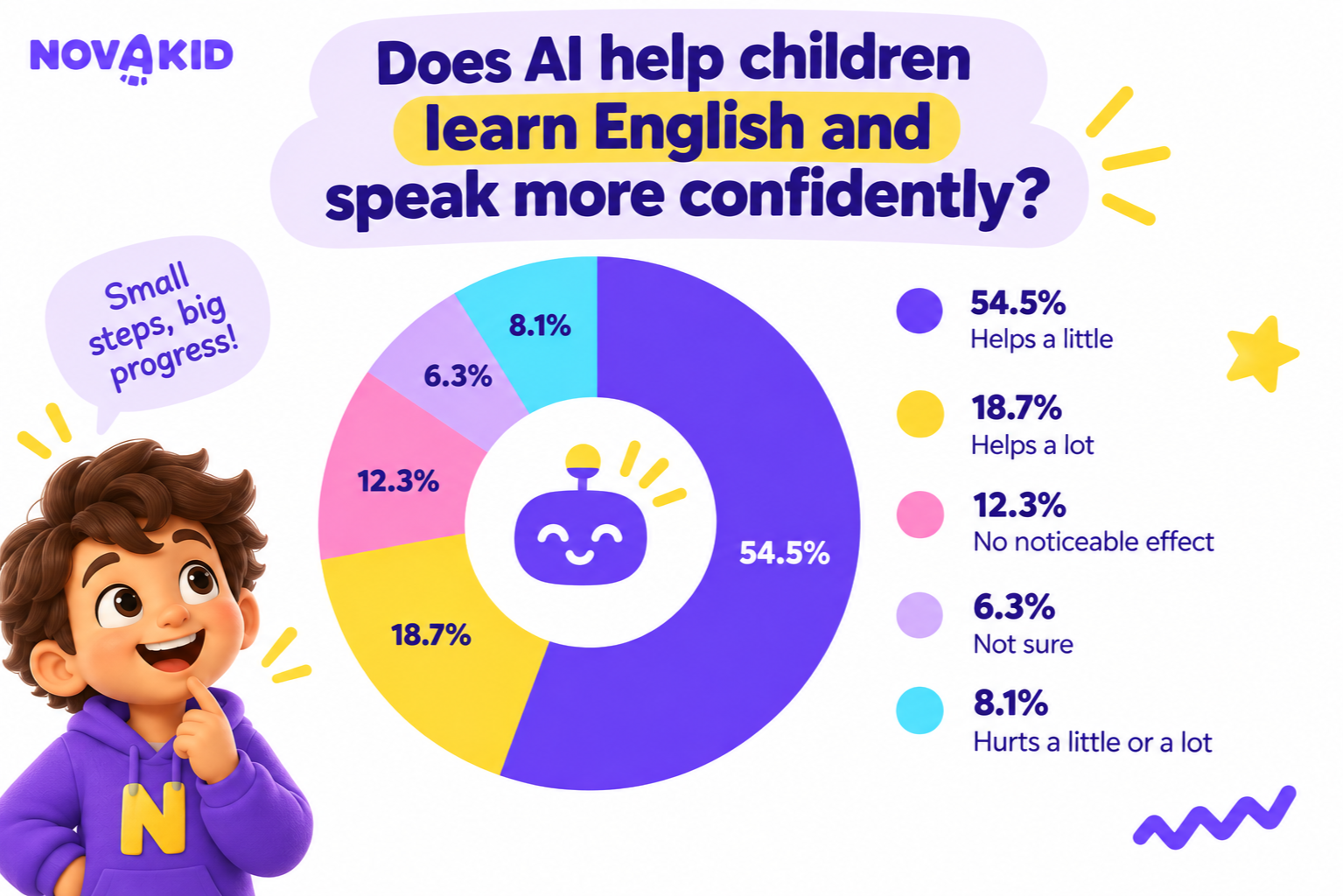
These are teachers’ opinions about speaking confidence. The survey did not measure changes in proficiency or establish that AI caused an improvement.
The written answers describe different experiences. One teacher wrote, “with proper guidance from adults, it helps”. Another mentioned students using AI to practice describing pictures, while also noting that some students became distracted. Other teachers reported incorrect generated images or dependence on the tool.
In our formula, AI is useful when it gives the learner an opportunity to understand language, recall words and create a response. If it supplies the entire response, the child has fewer opportunities to practice those steps.
Ownership provides a way to assess the activity: what the child understood and produced themselves, and what the tool provided.
The question is English easy to learn for foreigners cannot be answered by this survey or these studies alone. They did not compare English with other languages across different learner backgrounds. Our formula offers a framework for examining the conditions around that learning.
English learning = Exposure × Use × Consistency
The multiplier: ownership.
And it brings together four questions: does the child understand the language they encounter, have opportunities to use it, return to it regularly and take an active part in responding?
Parents can use these questions in conversations with their child’s teacher to identify what to practice next and what support to provide. The formula is a guide for that discussion, rather than a prediction of how quickly any particular child will learn.
At home, giving your child time to think and answer is a practical place to start. The next step is to offer regular opportunities to use English with a teacher who can guide the conversation and provide support when needed.
In Novakid’s online English classes for kids, children practice speaking one-to-one with teachers through conversations, games and interactive activities designed for young learners. These lessons give them opportunities to draw on familiar vocabulary, express their own ideas and try again with the teacher’s help.
Book a free trial lesson with Novakid and give your child a space to put their English into practice, one answer and one conversation at a time.
Resources
The critical importance of retrieval for learning – Jeffrey Karpicke and Henry Roediger 3rd (2008)
Fluency Training in the ESL Classroom: An Experimental Study of Fluency Development and Proceduralization – Nel de Jong and Charles Perfetti (2011)
Input spacing and the learning of L2 vocabulary in a classroom context – John Rogers and Anisa Cheung (2020)


There is no single answer for every child. Instead of focusing only on whether English is easy, consider how your child learns: do they understand the activities, have opportunities to speak and receive help when they need it?
Choose a familiar activity: read a short story together, sing a song or talk about favorite toys. Keep the language simple and give your child opportunities to join in, ask questions and share their own ideas.
Pause and give them time to think. If they still need help, offer a clue, simplify the question or give them two options. Then let your child attempt the answer themselves.
Ask your child to show you what they learned, choose English stories or songs together and take an interest in their lessons. You can also ask their teacher to suggest suitable activities and explain how much help to offer.
Discover how AI is transforming English learning. Explore the benefits of 24/7 tutoring, the risks of cognitive atrophy, and the future of education.
Is it possible for a child to master English in just three months? We dive into the scientific reality of language acquisition timelines vs. popular expectations.

Discover how the TPR method enhances online English learning for children. Movement, motivation and better results – even through a screen.
Discover how attention spans and screen fatigue affect children’s learning, and which strategies help maintain focus in online English lessons.
Insights from English teachers on children’s speaking confidence, vocabulary retention, home practice, AI and the role parents play in language learning.
A survey of over 130 English teachers reveals why English classes still matter for kids in the age of AI.
We and our partners use cookies to improve your experience, personalize content and ads, and analyze traffic. By clicking 'Accept all', you agree to our use of cookies in accordance with the Cookie Policy.
You can personalize your choices by clicking on 'Cookie settings'.
We use four types of cookies on our website. You can learn more about cookies and how we use them here: Cookie Policy
Strictly necessary
Advertising
Analytics
Personalization