



Explore what research and teachers say about homework AI, the pros and cons of homework, and why kids need lighter tasks and smarter use of AI.


We asked 347 Novakid English teachers from around the world what really helps children learn, based on what they see in their classes every day. Their answers shed light on what helps children overcome speaking anxiety, which activities help them remember new vocabulary, how much extra English practice they need at home, and how parents can support learning at home in a way that builds confidence rather than pressure.
What really helps children learn English? Is it better to watch a cartoon in English or practise with flashcards? What can help a shy child feel more comfortable speaking? And how much can parents do at home to support what happens in class?
These are some of the questions parents often ask when they want to understand what actually makes a difference in a child’s English learning journey.
To look beyond the theory, we asked 347 Novakid English teachers from around the world to share what they see in their classrooms every day. We wanted to understand what works, what helps children make progress and what can make learning English easier and more engaging. Here is what they told us.
Speaking English is not just about knowing the words and the grammar. It is also about feeling confident enough to say those words out loud, use the language to communicate and take part in a real conversation. A child may understand what they hear and may even know exactly what they want to say, but saying those words out loud can feel difficult.
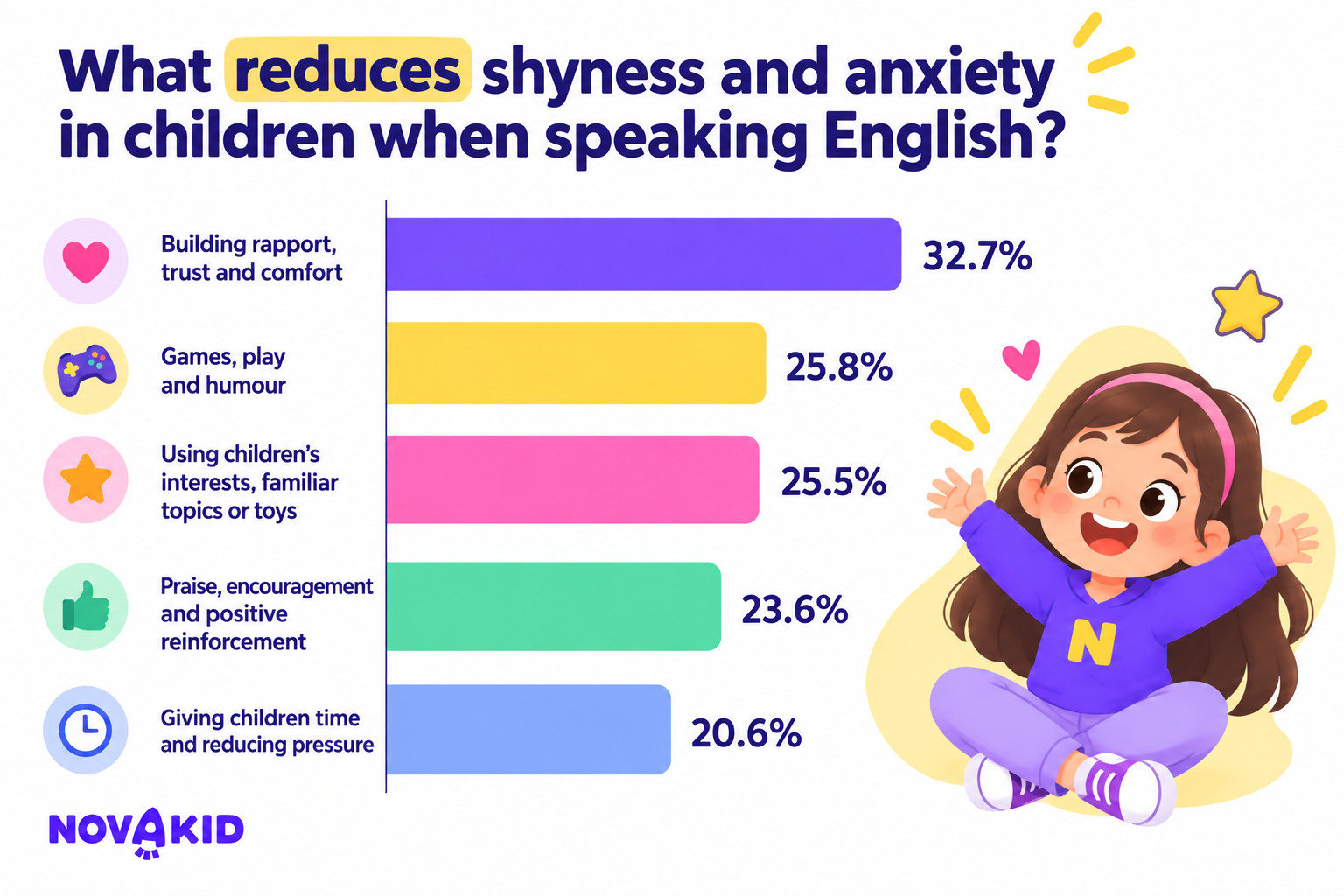
A good teacher helps a child overcome shyness and build confidence over time. But how? We asked teachers a simple question: “What’s your n.1 technique for reducing a student’s shyness or anxiety when speaking?”
The most common theme was building rapport, trust and comfort, mentioned in 32.7% of responses. Teachers described creating a positive relationship with the child, making them feel at ease and showing genuine interest in who they are. Games, play and humour appeared in 25.8% of responses, while using children’s interests, familiar topics or toys was mentioned in 25.5%. Praise and encouragement appeared in 23.6% of responses, and giving children enough time to respond and reducing pressure in 20.6%.
“I use my puppy as a prop or my Stitch teddy bear.”
“I sometimes ask students to teach me a simple word in their own language. This helps them feel that they are smart and capable, and that they are not struggling because they don’t know anything—they are simply still learning English.”
The common thread is simple: before children can speak English confidently, they need to feel confident speaking English. For teachers, creating that confidence can start with something as simple as making a child feel comfortable, interested and ready to join the conversation.
If feeling confident is key to building the ability to speak, how can parents help build that confidence? Parents naturally want to help their children learn English at home, and their support can make a real difference. But are they always helping in the way that works best for the child?
We asked Novakid teachers to share what they see from parents and, more specifically: “What’s the most common mistake parents make when helping their child with English at home?” The picture that emerges is of parents correcting every little mistake and sometimes wanting to help so much that they take over.
“Sometimes parents took over the class instead of just providing guidance to the student.”
“Parents usually want to help, but answering for the child too quickly can reduce opportunities for the student to think, recall vocabulary, make mistakes, and build confidence independently.”
“The most common mistake I see from parents is over-correcting every minor grammar mistake or mispronunciation in real-time, which can make children self-conscious and hesitant to speak”.
Teachers frequently mentioned parents answering for the child, finishing a sentence or giving them the word they are looking for when they take too long. It usually comes from a good intention: nobody wants to see their child struggle. But that moment of struggle can actually be useful. It gives children time to think, search for a word and discover that they can communicate on their own.
Another recurring theme was over-correction. Pronunciation, grammar and vocabulary can all become a focus of attention but correcting every mistake can quickly change the atmosphere. Instead of thinking about what they want to say, children may start thinking about whether they are saying it correctly.
Teachers also mentioned pressure, discouragement and an excessive focus on getting things right. When English starts to feel like another school task, children may become less willing to experiment with the language — and especially less willing to speak.
The takeaway from teachers is that there is a difference between helping a child improve and taking control of the conversation. Children need time to think, opportunities to find their own words and the freedom to make mistakes while they are learning.

Parents can play an important role in helping their children learn English by creating opportunities to use the language at home in a way that feels natural, rather than like extra study. There are many ways to bring English into a child’s everyday life: cartoons, songs, short conversations, reading books and games. But which activities make the biggest difference?
We asked teachers “Which home-support activities actually move the needle for your students?” Talking in English daily was the most frequently selected activity, mentioned by 86.4% of teachers, followed by watching videos and cartoons to get exposure to sounds, words and expressions. Also reading and songs give children another way to hear and repeat language.
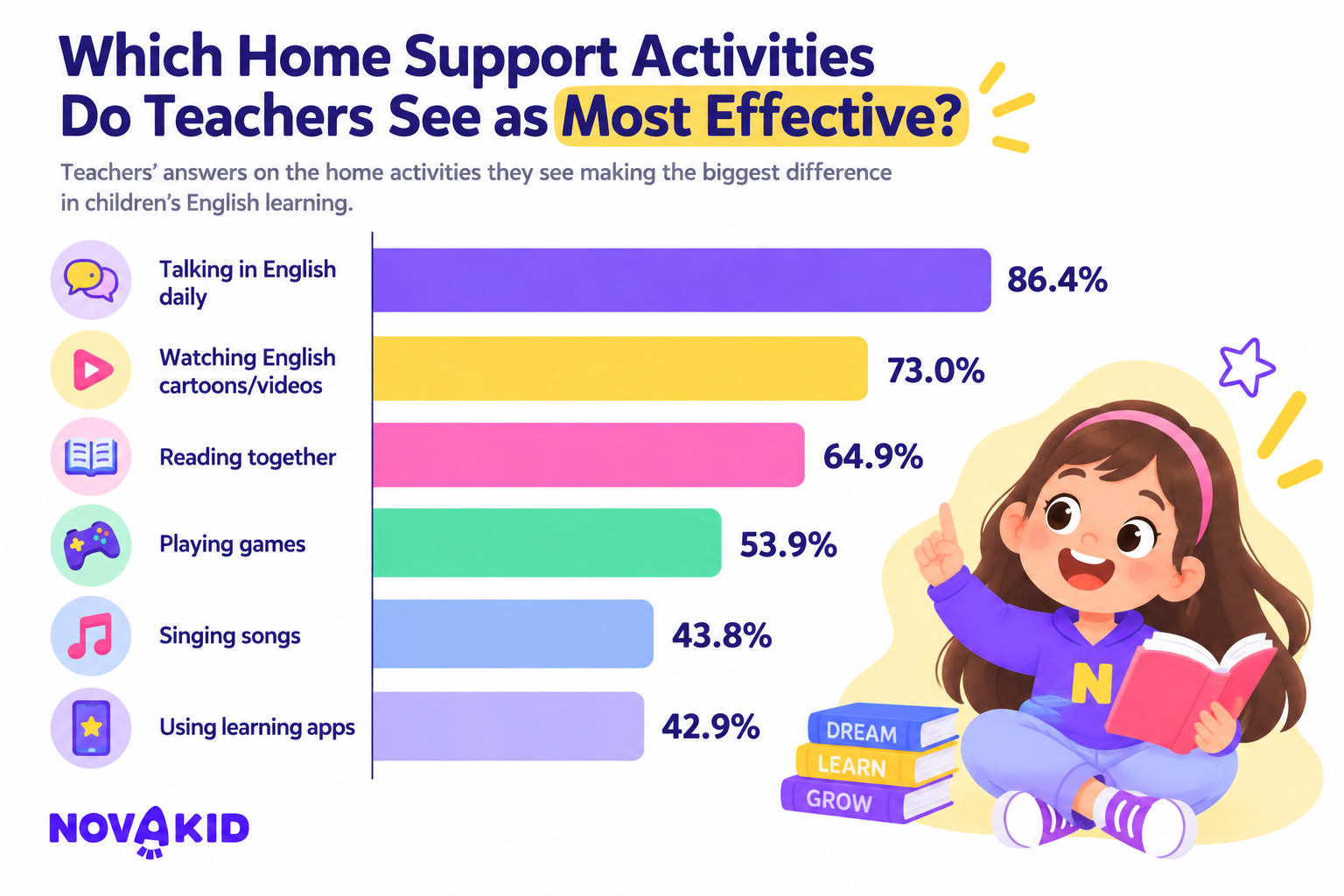
While songs, cartoons and reading all play a part in learning new words and being exposed to the sound of English, conversation is key: it gives children the chance to retrieve what they know and use it for a purpose. Instead of simply recognising a word, they have to find it, say it and connect it to what they want to communicate.
Before children can start using English in conversation, they need words to work with. Words are the building blocks of language: the more words children understand and remember, the more easily they can find the words they need to speak.

There are many ways to help children learn new vocabulary. Flashcards, games, songs and stories can all introduce and reinforce new words. We asked teachers which activities they find most helpful for remembering new vocabulary.
Flashcards received the maximum score from 43.8% of teachers, followed by real conversation practice at 40%, games at 39.8%. Songs and stories were rated as the most effective activities by 21.8% and 12.5% of teachers respectively.
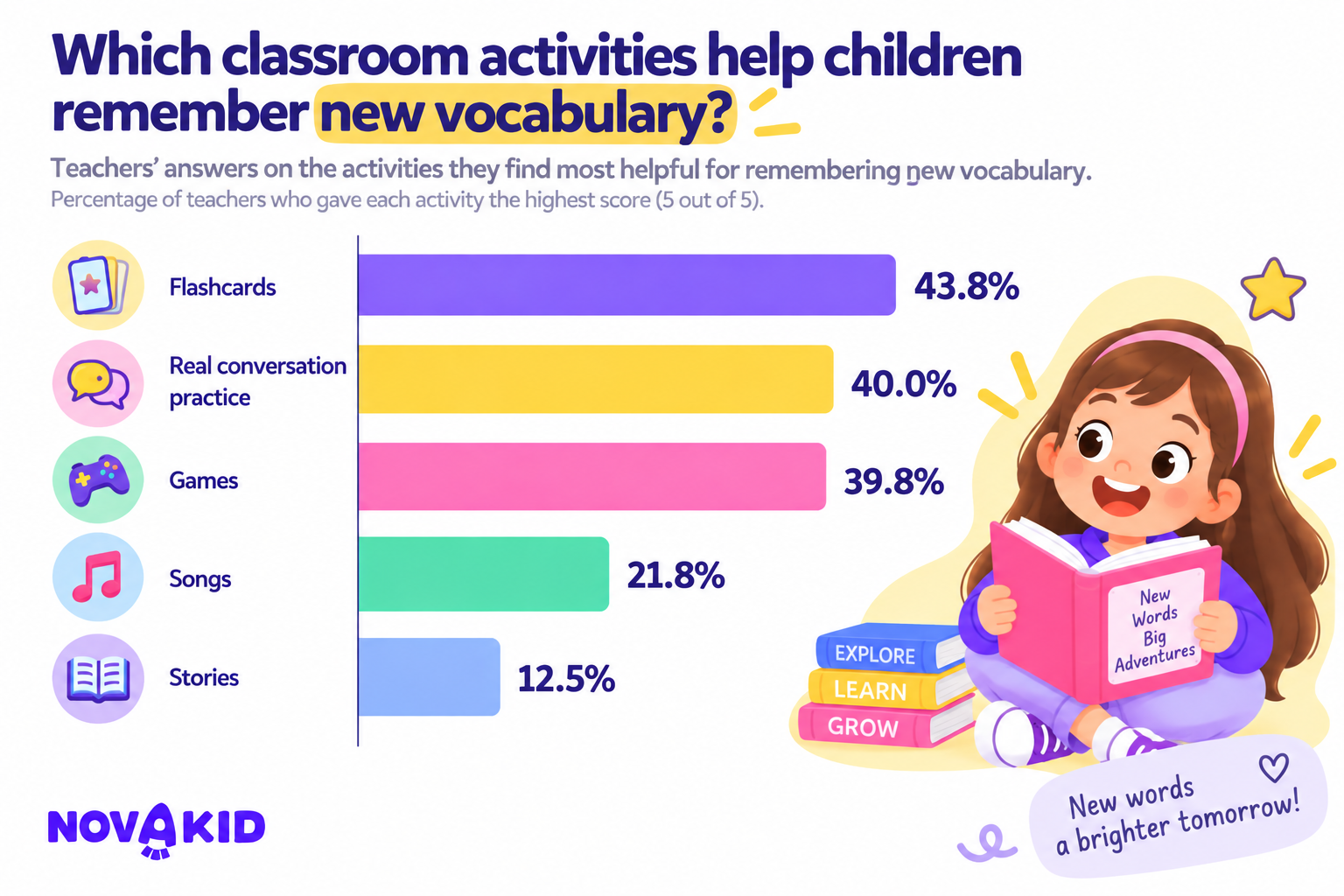
These results show that children can encounter and practise new words in many different ways. A flashcard can help them connect a word with an image. A game can make repetition more engaging. A song can help them hear the same words several times, while a story can place new vocabulary into a meaningful situation.
Conversation remains an important part of this process. Once children have met a new word, using it in a real exchange gives them a reason to remember it and use it actively.
With so many activities to choose from, parents who want to help their children learn English may be tempted to add a lot of extra practice at home, on top of regular English classes. So how much extra practice is ideal?
We asked teachers how much extra time of English practice per week they think children need to see a noticeable improvement. The most common answer was 15–30 minutes per week, selected by 38.6% of teachers, followed by 30–60 minutes, selected by 32.8%.
The message is encouraging for parents: helping your child learn English does not have to take a lot of time. What matters is making those extra minutes count. A few minutes of English in a way that feels natural and fun to the child can create valuable opportunities to
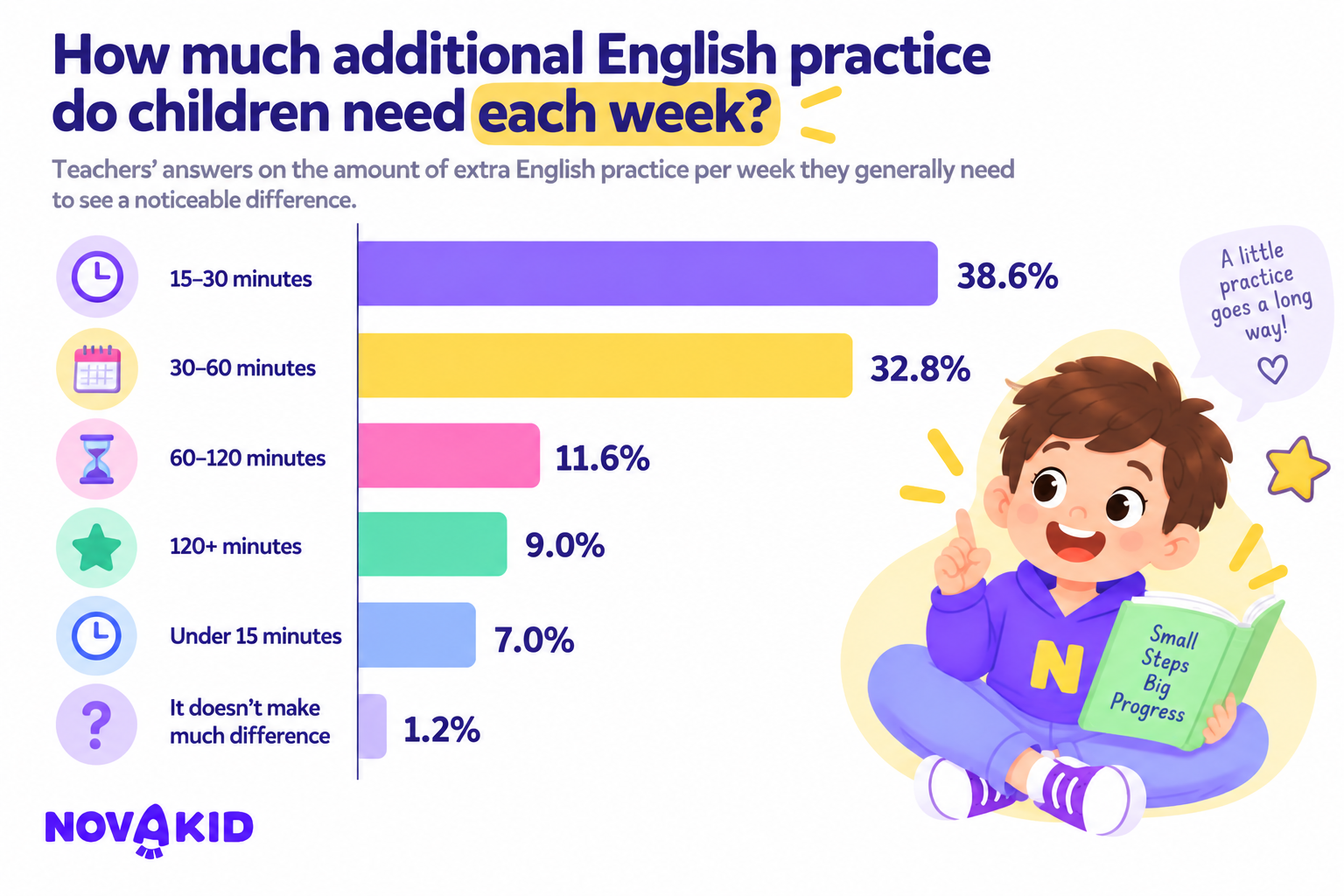
And those opportunities do not have to look like traditional studying. Reading a favourite book, watching a familiar cartoon, singing along to a song or playing a game in English can all give children another reason to listen, recognise words and use what they already know.
The key is to give English a place in everyday life. The more naturally children encounter the language, the more opportunities they have to connect what they learn in lessons with real situations, interests and activities they already enjoy.

Should AI have a part in a child’s learning journey? And does practising with an AI tutor actually help children feel more confident speaking?
In our survey, 68.5% of teachers reported that at least some of their students use AI tools such as ChatGPT, voice assistants or AI chatbots to practise English outside class. We asked if AI helps children feel more confident when speaking English, the answer was largely positive: 73.2% of teachers said AI helps speaking confidence, although most described the effect as limited.
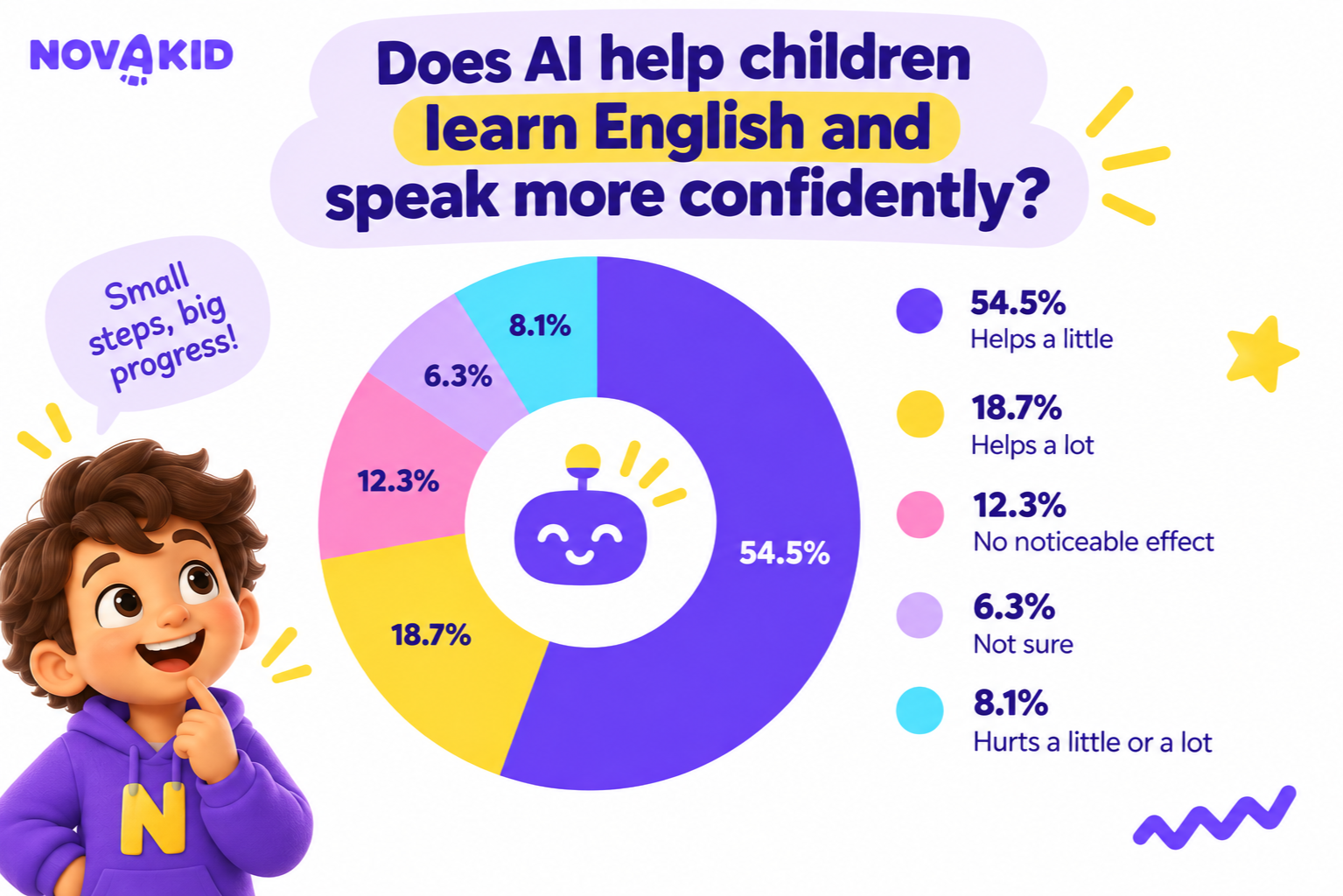
According to the teachers surveyed, AI can therefore be a useful additional tool for English practice, particularly when children need extra opportunities to use the language. AI can support English practice, but it does not replace real human conversation.
Parents often want to know how long it will take before their child starts speaking English confidently. They may look for a clear timeline or hope to see noticeable progress quickly. But there is no single answer: every child learns at their own pace, and age can also make a difference. So we asked teachers: At what age do you tend to see children pick up conversational English fastest?
The answers point to a pattern. 30.4% of teachers said they see this most clearly around ages 8–9, while 18.6% pointed to ages 6–7. Overall, 49% of teachers selected an age between 6 and 9.
This does not mean that children should start learning English at 6, 7, 8 or 9. The question asked teachers when they tend to see children pick up conversational English fastest.
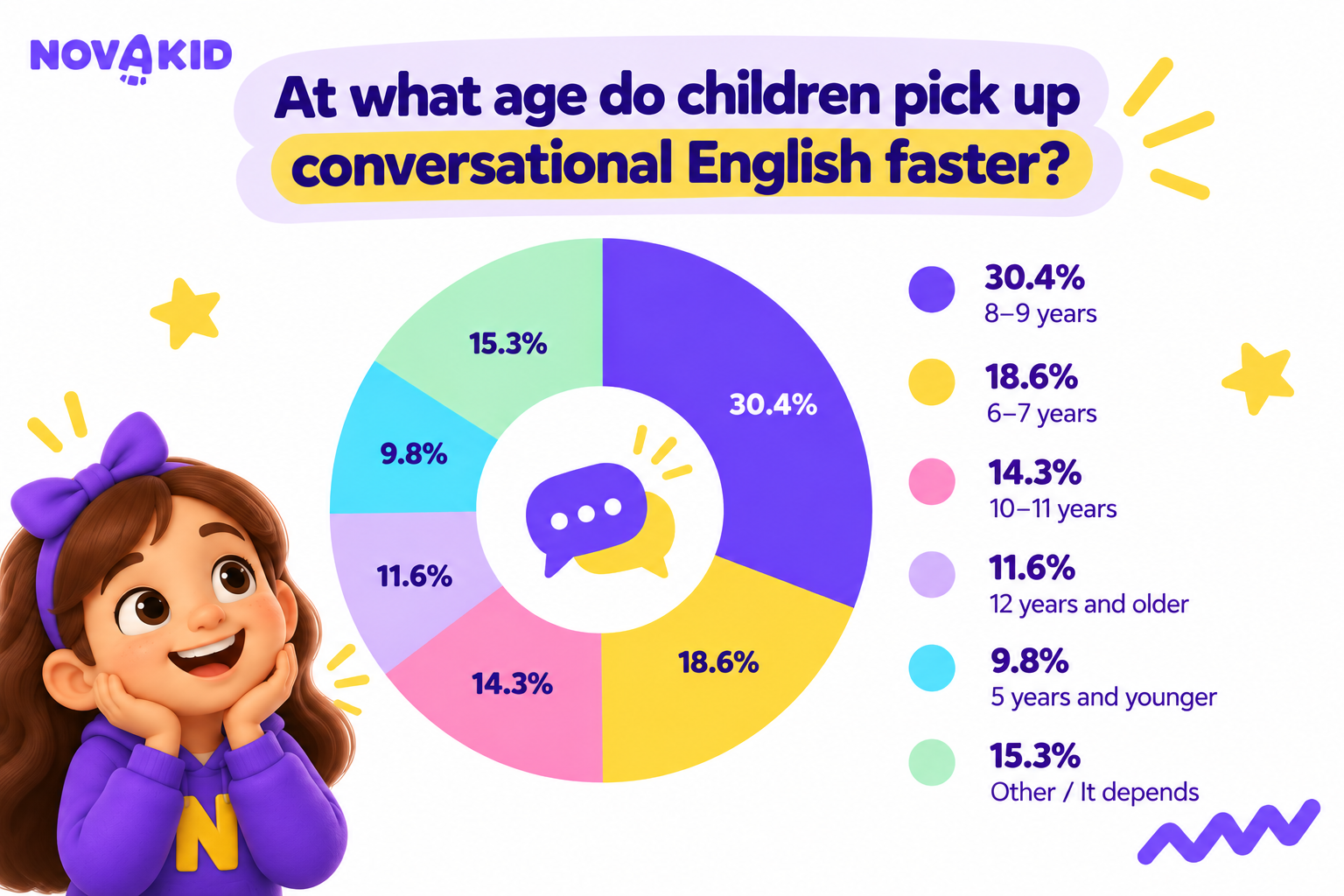
What happens before this point still matters. Early exposure helps children build the foundations they can draw on later: familiar sounds, basic vocabulary, comprehension and confidence using English. Conversational English may accelerate as children grow.
Across the survey, teachers point to a simple principle: children make progress when English becomes something they use, not something they are constantly tested on. Confidence comes before perfection, and children benefit from having time and space to think, speak and make mistakes. Conversation, games, stories, songs and other activities can all play a role, while regular exposure gives children more opportunities to meet and practise the language.
The message for parents is simple: you do not have to become your child’s English teacher. Your role is not to correct every mistake or turn every activity into a lesson. It is to create opportunities for your child to encounter and use English naturally, in ways that feel enjoyable and part of everyday life.
Early exposure can help build the foundations, while real communication gives children the opportunity to turn those foundations into language they can actually use. And sometimes, the most helpful thing a parent can do is simply give a child the time and confidence to find their own words.
This is also the principle behind Novakid English School, where children learn English through age-appropriate online activities and real communication with a teacher.


Explore what research and teachers say about homework AI, the pros and cons of homework, and why kids need lighter tasks and smarter use of AI.
Is it possible for a child to master English in just three months? We dive into the scientific reality of language acquisition timelines vs. popular expectations.
Discover how AI is transforming English learning. Explore the benefits of 24/7 tutoring, the risks of cognitive atrophy, and the future of education.

This Novakid article reveals why some children learn English faster than others — from personalised attention, to confidence, consistency, and cognitive style.
Individual or group lessons? Online or offline classes? Study with a tutor or an app? Exploring the benefits of one-on-one lessons over other types of classes.
Discover the teaching methods actually working in 2026. From AI integration to immersive play, explore the new paradigm of English education for children.
We and our partners use cookies to improve your experience, personalize content and ads, and analyze traffic. By clicking 'Accept all', you agree to our use of cookies in accordance with the Cookie Policy.
You can personalize your choices by clicking on 'Cookie settings'.
We use four types of cookies on our website. You can learn more about cookies and how we use them here: Cookie Policy
Strictly necessary
Advertising
Analytics
Personalization