



Learn what Total Physical Response (TPR) is, how Novakid teachers use it in class, and why this teaching approach supports English language learners through movement and communicative language teaching.

“It happens all the time—kids know exactly what to say, but when you ask them to speak, they clam up. I don’t think it’s usually about not knowing the answer or lacking vocabulary. More often, in language learning, it’s just nerves or not feeling ready to speak up. We sometimes forget that using a language out loud can feel a lot scarier than understanding it in your head,” says Ali Sullivan, a teacher working with Novakid for over seven years.
Researchers have long examined foreign language anxiety: the tension, worry or fear that can appear specifically when learning or using another language. Speaking tends to make that discomfort particularly visible because it happens in real time, and there is little to no opportunity to quietly rethink an answer, check a spelling or erase a mistake. For some children, that can create a very real fear to talk.
To find out what helps in practice, Novakid surveyed 347 English teachers between August 21 and September 3, 2026. Their answers point in the same direction: children speak more freely when English feels less like a performance and more like communication.
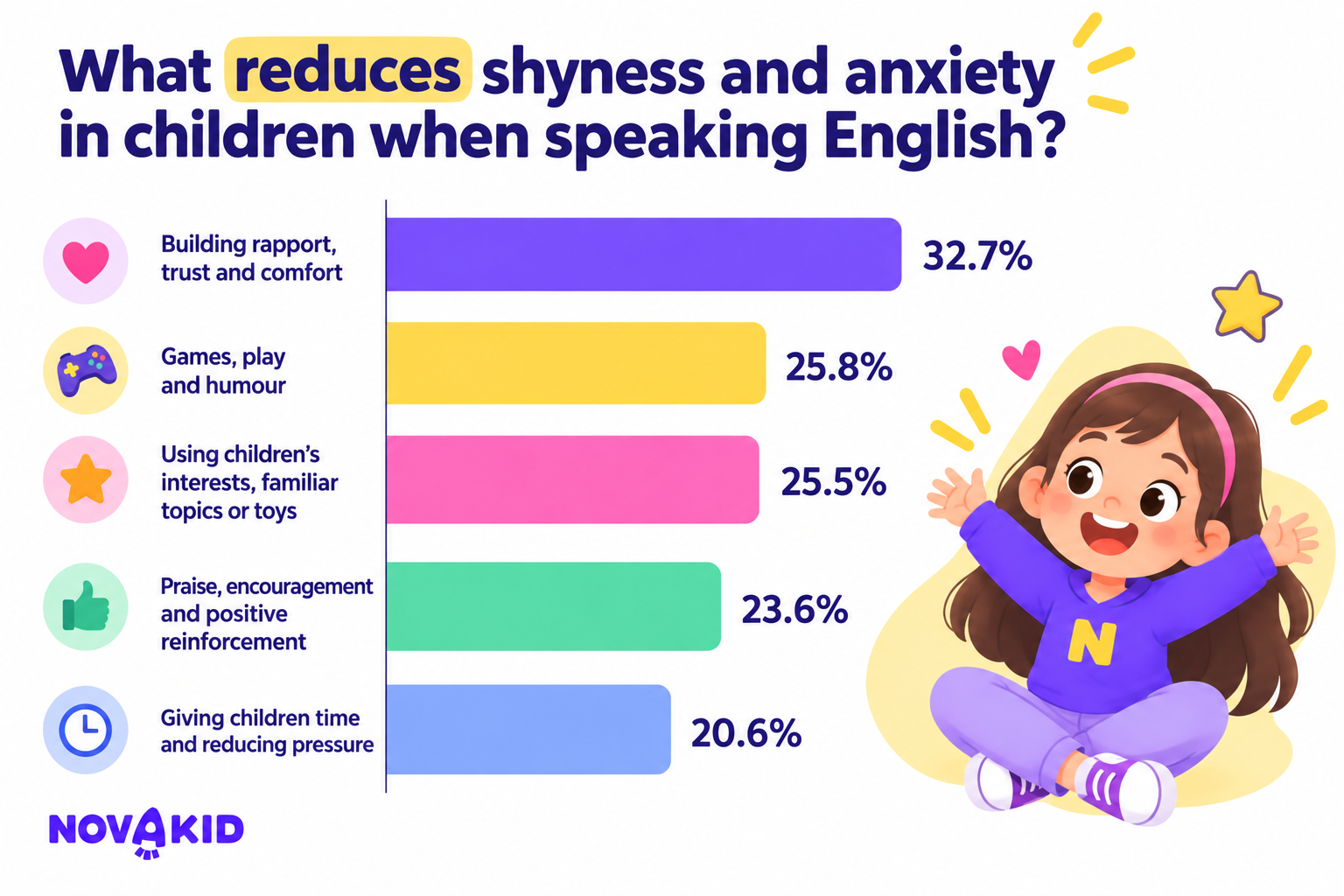
Among others, we asked teachers a simple question, “What’s your #1 technique for reducing student’s shyness or anxiety when speaking?”, and the most common answer, given by 32.7% of them, was simple: build rapport, trust, and comfort.
That means building a positive relationship, ensuring the child feels at ease, and showing genuine interest in who they are. Games, play, and humor came up in 25.8% of responses, with using children’s interests, familiar topics, or toys close behind at 25.5%. Praise and encouragement were mentioned in 23.6% of answers, and giving children enough time to respond and reducing pressure showed up in 20.6%.
Research into second language anxiety and willingness to communicate adds a further layer to that picture. While much of it has been conducted with university students and adult learners, an important limitation when discussing children, studies suggest that anxiety, classroom climate, task design and the way feedback is delivered can all shape a learner’s willingness to speak.
So what can parents and teachers actually do? Let’s see what we can extract from the Novakid survey, where teachers from all over the world told us what they do every day with their students to overcome shyness and make them shine in class:
One of the clearest themes in the Novakid survey was remarkably simple: take some of the seriousness out of speaking.
Teachers repeatedly mentioned games, toys, puppets, funny voices, jokes and conversations about a child’s interests as ways to get reluctant speakers talking.
As one Novakid teacher put it:
“Make speaking feel like play, not a test. Start with easy questions, praise effort, and give them time to answer without interrupting or correcting every mistake.”
There is a useful distinction here. Practicing English does not always have to look like studying English.
Asking a child to name every object in a picture can feel like an assessment. Pretending that a teddy bear understands only English creates a reason to communicate.
A 2026 study published in BMC Psychology examined the relationship between foreign language enjoyment, anxiety and willingness to communicate among 478 Chinese university students. The researchers found that foreign language enjoyment was positively associated with willingness to communicate, while anxiety was negatively associated with it. Teacher support also played a role in this relationship.
Because the participants were adults, the findings should not be treated as direct evidence about young children. But they support a broader principle that appears repeatedly in Novakid teachers’ responses: the emotional environment in which speaking occurs matters.
For parents looking for techniques to reduce nervousness, play may therefore be a better starting point than another formal speaking exercise.

Parents understandably want children to speak correctly. But correcting every mistake can accidentally make accuracy feel like the price of admission to a conversation and fuel public speaking anxiety.
One teacher in the Novakid survey described the problem this way:
“When parents constantly stop to correct every minor grammar or pronunciation error, it causes language anxiety and makes kids shut down. Instead of direct corrections, parents should use recasting—naturally repeating the child’s thought with correct grammar while keeping the conversation flowing.”
Another teacher identified the common mistake as:
“Over-correcting mistakes in real time—interrupting a child every time they mispronounce a word or use incorrect grammar instead of letting them finish their thought.”
This point is particularly supported by research involving younger language learners. In a study published in Foreign Language Annals, Mengxia Fu and Shaofeng Li examined 102 middle-school EFL learners and found that anxiety was associated with differences in how learners benefited from corrective feedback. The researchers argue that anxiety can place additional demands on learners’ cognitive resources.
Another study by Ehsan Rassaei and published in System in 2015, found that learners with different levels of foreign language anxiety responded differently to forms of oral corrective feedback. Among highly anxious learners, recasts proved more beneficial than metalinguistic corrective feedback.
The message you must remember is not “never correct a child”, because the learning process is different from one person to another and a negative evaluation can make a child very anxious.
Discover in the video below four practical ways to help your child feel more comfortable speaking English:
“What did you do at school today?”
For a confident speaker, that is an easy answer. For an anxious beginner, it can mean choosing vocabulary, building a sentence, remembering grammar and speaking it aloud — and all at once!
Several Novakid teachers said they reduce that load by starting much smaller.
One explained:
“Asking shy students open-ended questions causes pressure. Instead, I start with physical gestures (“Show me if you’re sleepy or energetic!”) and easy binary options (“Is the dog big or small?”). Physical movement releases tension, and simple choices build immediate confidence so they feel safe to speak up.”
Instead of “What would you like for dinner?”, try “Pizza or pasta?”
Instead of “Tell me about this dog,” try “Is the dog big or small?”
Then build from there: “The dog is big.” “The big dog is running.” “The big dog is running in the park.”
These are simple techniques to reduce nervousness because they lower the linguistic demands of the first response. Once the conversation has started, longer answers can follow.
This can be especially helpful when communication anxiety is making a child hesitate before they have even begun.
Sometimes the hardest part of an English sentence is simply… starting it.
One Novakid teacher calls sentence starters a “booster”:
“My best technique is to provide my student with what I call a “booster”. It is simply a sentence pattern to help them begin their answers. Sometimes, anxiety comes from uncertainty, so giving them a boost helps a lot. For example, I would begin with “My favorite toy is a…” and most of the time, they would confidently complete the sentence.”
Parents can do the same thing:
This kind of scaffolding can be particularly useful for children experiencing speech anxiety. They still choose what they want to communicate, but they don’t have to construct every part of the response from scratch.
It also offers one possible answer to how to overcome communication apprehension: make the first step small enough that speaking feels manageable.

One surprisingly difficult skill for adults helping children learn a language is waiting.
When a child pauses for a word, parents often jump in; when grammar goes wrong, they correct it, and when pronunciation is unclear, they ask the child to repeat it.
But a pause isn’t necessarily a failure. Sometimes it is simply thinking.
One Novakid teacher described their approach within the survey:
“Let the student speak first without interrupting or correcting them. After the student finishes speaking, praise them for their effort, then provide corrections in a polite and friendly way.”
Another wrote:
“One trick I let my students finish speaking first before correcting their mistake/s to build confidence over time. I also let them talk about the things that they are most interested about.”
That distinction matters when dealing with speech anxiety. If children learn that every hesitation will be immediately filled in by an adult, they get fewer opportunities to retrieve the word themselves and complete their own thought.
Just try waiting a few extra seconds.
Children quickly notice how adults react to mistakes.
If every wrong verb gets a worried face, an interruption, or “No, that’s wrong,” speaking English begins to feel risky. Several Novakid teachers therefore said they deliberately normalize mistakes.
One reported:
“Intentionally making mistakes in class (teacher and student switch roles) to make them feel it is okay to make mistakes.”
This changes what an error means. Instead of evidence that the child is “bad at English,” it becomes something expected part of learning English.
That distinction is particularly relevant to foreign language anxiety, which research has frequently associated with concerns about mistakes, evaluation and speaking performance.
For a child with a strong fear to talk, seeing an adult use flawed English, laugh about a mistake and simply try again can communicate something more important than another grammar explanation: you do not have to be perfect to participate.

The Novakid survey also suggests that speaking confidence does not require turning the family home into a second classroom.
When teachers were asked how much additional weekly practice they usually need to see a noticeable improvement, the two most common answers were surprisingly modest: 38.6% chose 15–30 minutes per week and another 32.8% chose 30–60 minutes.
More revealing, perhaps, is what teachers recommended doing at home.
About 86% selected talking in English daily as an activity that genuinely helps their students. Watching English cartoons or videos was selected by 73%, reading together by 65%, playing games by 54%, singing songs by almost 44% and using learning apps by 43%.
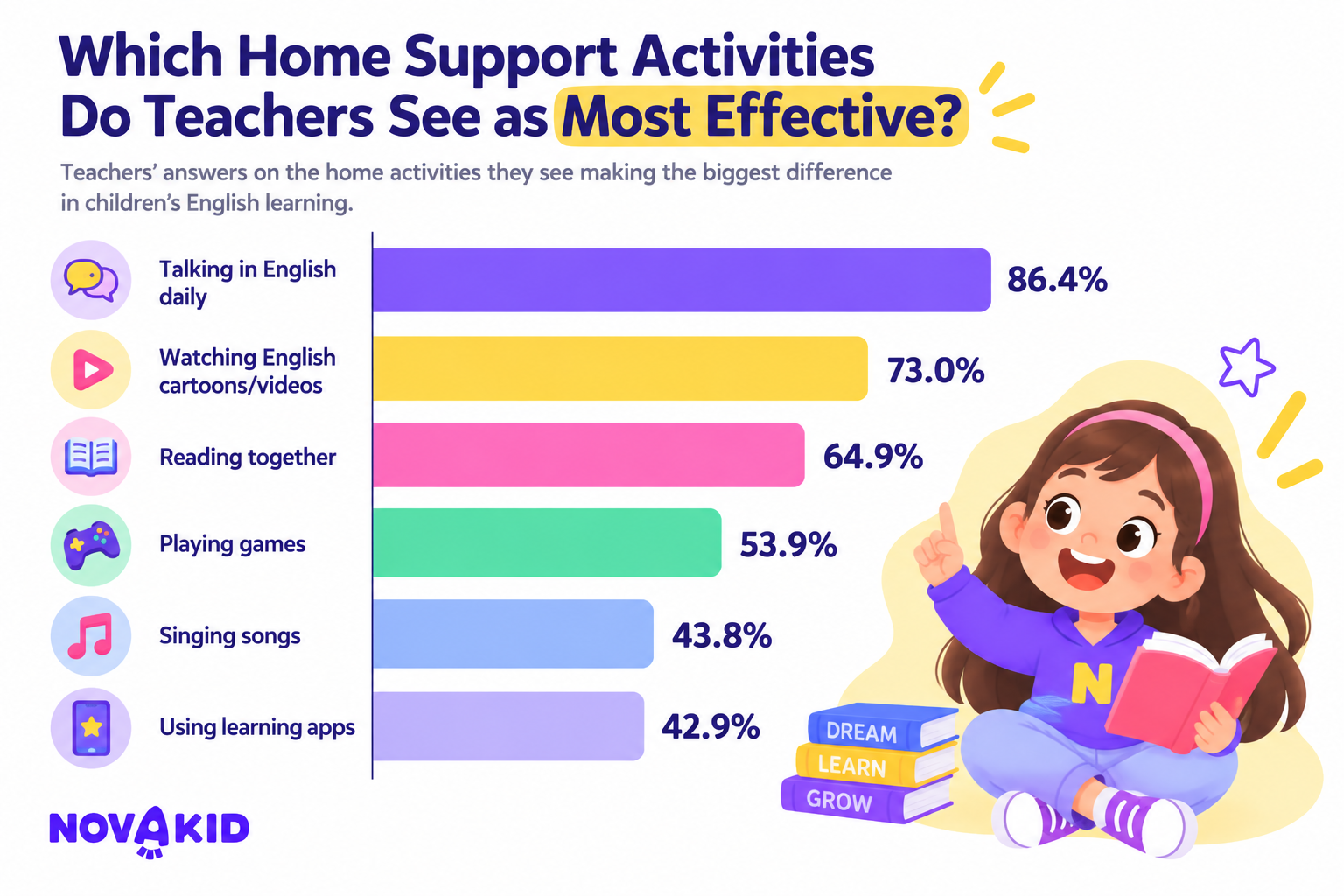
The pattern suggests that practice does not have to mean long sessions. Five minutes of English during breakfast, a short conversation about a cartoon or a game in the car all create opportunities to use the language but without turning it into an event.
That can matter for children with second language anxiety: ten small, predictable conversations may feel very different from one intimidating 50-minute “English practice” session.
Casual conversation is one thing, speaking in front of a class is another.
Older children may be perfectly comfortable chatting in English and still experience anxiety and presentations. In evaluative situations, the pressure is no longer simply “Can I say this?” but “What will everyone think if I say this wrong?”
A 2026 mixed-methods study published in Frontiers in Education examined speaking anxiety among final-year university English majors through different speaking situations. The study illustrates how evaluative contexts can increase anxiety and discusses the importance of anxiety-sensitive teaching practices.
Again, these were adult learners. The findings cannot simply be transferred to children. But they illustrate an important distinction: being able to chat in English does not automatically mean feeling comfortable giving a presentation in it.
For children struggling with anxiety and presentations, parents can rehearse the situation in smaller versions: first alone, then with one parent, then perhaps with another family member.
“Tell me about your summer holiday” may be a perfectly reasonable speaking prompt.
But if the child wants to talk about Minecraft, a football player, dinosaurs, a favorite character or the family cat, that may be where the conversation should start.
Interest appeared again and again in the Novakid teachers’ responses. Teachers mentioned asking about hobbies, favorite games, toys, pets, cartoons and common experiences as ways to get shy students speaking.
One teacher summarized the strategy simply:
“Allowing them freedom to speak with minimal correction and letting them choose topics they like.”
Familiar topics remove one difficulty from the conversation: children already know what they want to say.
When parents ask how to overcome communication apprehension, therefore, one useful approach may be to stop choosing every subject for the child and let them have something they genuinely want to say.
Find out in the video below four practical ways parents can make English learning easier, more enjoyable and more consistent at home:
Instead of asking, “How many mistakes did you make?”, ask, “Did you manage to say what you wanted to say?” and instead of praising only a grammatically perfect answer, notice the attempt: “You explained that whole idea in English!”
This matters because communication anxiety can make speaking itself feel like a test. When children become preoccupied with getting every word right, they may become less willing to try.
The goal is not to lower expectations indefinitely. Accuracy, pronunciation and grammar matter, of course. But confidence and accuracy do not always have to be trained at exactly the same moment.
One Novakid teacher described the approach:
“Make speaking low-pressure and praise effort”
That may be one of the most useful principles to emerge from the survey.
Trying to remove every trace of nervousness is probably the wrong target. Speaking another language involves uncertainty. Children will forget words; they will pronounce things strangely and build statements that make perfect sense in their heads and considerably less sense when they come out.
The more useful goal is to make those moments safe enough for the child to keep talking.
For parents worried about their child’s foreign language anxiety, the Novakid teacher survey sends a clear message: children just need more opportunities to use English without feeling judged.
So, give your child a place to practice speaking English!
Knowing what to do at home is one part of the picture. Children also need regular opportunities to have real conversations in English with someone who can adjust the language, questions, and feedback to their level.
In Novakid’s online English classes for kids, students practice speaking one-to-one with teachers through conversations, games and interactive activities created for young learners. It gives children a regular space to use English rather than simply study it and to discover that making a mistake does not have to stop the conversation.
Book a free trial lesson with Novakid and give your child more opportunities to turn the English they know into English they can actually speak!
Resources
Understanding L2 willingness to communicate: the interplay of growth mindset, foreign language enjoyment and anxiety – Tingting Zhang, Maria Sultana & Rukhsana Bibi (2026)
The associations between foreign language anxiety and the effectiveness of immediate and delayed corrective feedback – Mengxia Fu & Shaofeng Li (2023)
Oral corrective feedback, foreign language anxiety and L2 development – Ehsan Rassaei (2015)
Speaking anxiety in evaluative contexts: evidence from final-year EFL students and implications for anxiety-sensitive pedagogy – Vuong Thi Hai Yen (2026)


Start with short, low-pressure conversations about familiar topics. Practicing regularly, allowing time to answer and focusing on communication rather than correcting every mistake can make speaking feel more manageable.
Build up gradually: practice alone first, then with someone you trust, and move towards more challenging situations. Familiarity and repeated speaking practice can help reduce the pressure associated with using English.
The 3-3-3 rule is a grounding technique: name three things you can see, three things you can hear, and move three parts of your body. It is commonly suggested as a way to redirect attention to the present moment, although it is not a specific treatment for speaking anxiety.
Slow down, allow pauses and focus on getting your message across rather than speaking perfectly. If speaking anxiety is persistent or significantly affects everyday life, professional support may also be appropriate.
It is commonly discussed as foreign language anxiety, second language anxiety, or more specifically foreign language speaking anxiety. It can involve fear of making mistakes, being evaluated or speaking in front of others.
Learn what Total Physical Response (TPR) is, how Novakid teachers use it in class, and why this teaching approach supports English language learners through movement and communicative language teaching.

Halloween is a perfect occasion for you and your kid to learn some English! Study new vocabulary & find a perfect Halloween film. Go Monsters!
Interactive games, role-play, songs, repetition, storytelling and much more! Find out which teaching methods work best for teaching English to children online.

Although the transition from private tutors to online education platforms was swift, parents had their time to decide how they felt about the opportunity to choose a teacher. The only question remains: how does one know the school is right for their kid, or they should change it?

A game is a natural way for a child to learn. Games also facilitate a child’s spontaneous use of language, coordination, memory, alertness, thinking, etc.

Motivation is the key to learning any language; a 5- or 10-year-old may experience age-specific troubles. With a teacher who fails to motivate, English is lost on a kid.
We and our partners use cookies to improve your experience, personalize content and ads, and analyze traffic. By clicking 'Accept all', you agree to our use of cookies in accordance with the Cookie Policy.
You can personalize your choices by clicking on 'Cookie settings'.
We use four types of cookies on our website. You can learn more about cookies and how we use them here: Cookie Policy
Strictly necessary
Advertising
Analytics
Personalization