



This article lists Disney animations which may be a great tool helping children learn English.


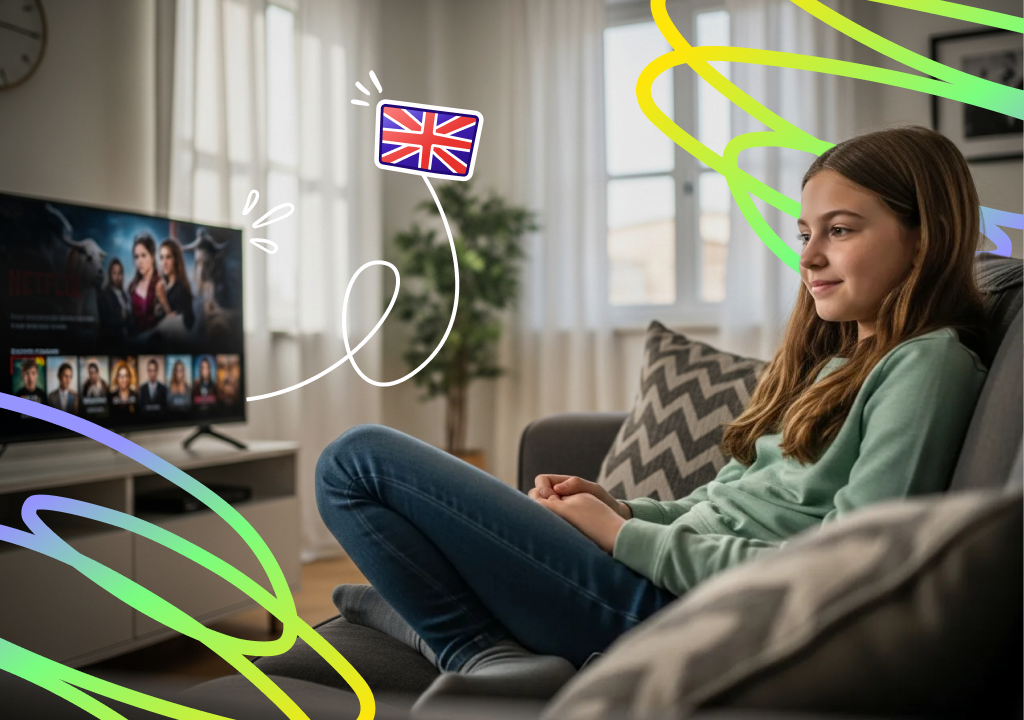

You’ve probably read that immersing your child in the target language—whether that’s English, Spanish, or another language—is key to helping them reach fluency. Which means you’ve thought about showing them kids shows and movies on streaming platforms like Netflix.
But is language learning with Netflix even possible for kids? And how should you approach it? In this guide, we’ll explore how watching shows and films on Netflix can help your child improve their language skills. We’ll also provide practical tips to help your kid get the most out of their language learning on the streaming platform.
Yes, children can learn a language through Netflix. There are a slew of quality kids’ movies and shows in various languages on Netflix.
What’s more, a Journal of Cognition review article examining 93 studies on the impact of video on language learning concluded that these studies indicate children can learn new language forms when exposed to them through video (television, film, etc).
The review article also concluded that these studies indicate high-quality, child-directed television in particular can aid language development in children.
That said, video media—whether television, film, or educational clips on YouTube—can’t replace shared book reading and other enriching activities. In other words, you shouldn’t rely solely on video streaming services like Netflix to build your child’s language skills.
Instead, you should combine their video-based media consumption with other forms of language immersion and acquisition, including:
That way, your child doesn’t just memorize words and phrases—they actually master the language.
Watching high-quality TV shows and films on Netflix can benefit your child’s language development in the following ways:
Language learning with Netflix is more viable than many parents realize, but you have to approach it the right way. Here are eight practical tips to help you use Netflix to effectively build your child’s language skills.
Successful language learning with Netflix starts with understanding your child’s language level. After all, you can’t pick a B1-level show and expect your A0-level child to follow along.
You can determine your child’s language level by:
Once you’ve identified your child’s language level, research which Netflix shows align with that level (more on that in the recommendations section!)
Does your child like learning about animals and playing outdoors? Or, do they like fairy princesses and dressing up their Barbie dolls?
Choose Netflix shows and movies that cater to their interests so your kid actually enjoys the content and focuses on the language used.
After all, according to a Frontiers in Psychology review article on enjoyment in foreign language education, learners who experience enjoyment perform better in language learning.
So, if your child loves superheroes, put on Teen Titans Go! and watch how they smile, laugh, and even repeat expressions the characters say unprompted!
Beginning with a show or film that your child is already familiar with in their native language allows them to track the translation.
For example, your child might know the Spanish version of the Finding Nemo scene where Marlin and Dory encounter a whale in the ocean.
That means, they’ll be able to catch some of the words and expressions that have been translated from Spanish, including:
You can use Netflix language learning extensions to support your child’s language acquisition. These browser extensions (available on Chrome, Safari, Edge, and/or Firefox) provide subtitles in your kid’s target and native language so they can see how different words translate.
Popular extensions include:
Use either of these extensions as a scaffolding tool. Let your child use the subtitles to get familiar with the target language, then remove them gradually as your kid develops better listening comprehension skills.
Eventually, they’ll understand entire episodes and films without support.
Subtitles aren’t the only aspect of the viewing experience that’s in your and your child’s control.
If at any point your kid misses a line of dialogue, they can use the rewind button to return to the line in question. They can also rewatch full scenes without glancing at the subtitles to see if they understand the dialogue on their own.
If you have an ad-free plan, another setting to take advantage of is playback speed. If a speaker talks too quickly and your child can’t keep up, decrease the speed. They’ll pick up on things like pronunciation and mouth movements used to produce certain words and letter sounds.
There’s a reason why teachers emphasize “talk time” in their lessons. Follow their lead by encouraging your child to repeat words and expressions from the movie or show they’re watching.
Bonus points if they’re words and sayings your kid is working on in school!
Try show or movie-based role-playing exercises, too. If your kid watches Avatar: The Last Airbender, take turns role-playing as Aang or Katara.
You can ask them questions and challenge them to respond based on details from the show, strengthening their vocabulary and improving knowledge retention by making learning more engaging.
Don’t just let your kid passively watch TV shows and movies. Ask them questions about the scene, characters, setting, and other details.
This promotes active learning, which fosters language acquisition. In fact, a LEARN Journal study on active learning showed that English as a Foreign Language (EFL) students who were exposed to active learning lessons scored 1.57 points higher on average on an English post-test than they did on the pre-test when they weren’t exposed to active learning lessons.
So, if you’re watching Kung Fu Panda together, ask questions like “Who’s your favorite character, and why?” and “What is Po doing in this scene?”
Encourage them to answer in the target language. This gives your child a chance to demonstrate their listening comprehension, vocabulary, and speaking skills.
There will be plenty of words that your child doesn’t know. As they watch cartoons and kids’ movies on Netflix, have them pause and jot down unfamiliar words.
They can research these words later, write down their definitions, and even come up with their own sample sentences.
For example, your child might not know what the word “master” means when watching Pokémon. But they can jot it down, look it up, and work with you to write the sentence “Ash wants to become a Pokémon master.”
So what shows and movies should you and your child watch on Netflix, anyway?
The tables below provide 10 TV recommendations and 10 movie recommendations, with each title categorized by genre, age group, and CEFR level.
Keep in mind that these shows were available to US-based Netflix users as of May 2026.
Netflix TV Shows for Kids | |||
|---|---|---|---|
| Title | Genre | Age Group | CEFR Level Range |
| Peppa Pig | Preschool | 3+ | A0-A1 |
| PAW Patrol | Adventure | 3+ | A0-A1 |
| Dee & Friends in Oz | Fantasy | 3+ | A0-A1 |
| Little Baby Bum: Music Time | Musical | 2+ | A0–A1 |
| Hilda | Adventure | 6+ | A1-A2 |
| My Little Pony: Friendship Is Magic | Comedy | 5+ | A1–A2 |
| Strawberry Shortcake: Berry in the Big City | Adventure | 5+ | A1–A2 |
| Super Giant Robot Brothers | Action | 6+ | A2–B1 |
| Avatar: The Last Airbender | Fantasy | 8+ | A2-B1 |
Netflix Movies for Kids | |||
|---|---|---|---|
| Title | Genre | Age Group | CEFR Level Range |
| Spookley the Square Pumpkin | Musical | 4+ | A0–A1 |
| Super Monsters: The New Class | Fantasy | 3+ | A0–A1 |
| Thomas & Friends: Race for the Sodor Cup | Adventure | 3+ | A0-A1 |
| PAW Patrol: The Movie | Adventure | 4+ | A0–A1 |
| Barbie: Mermaid Power | Musical | 5+ | A1-A2 |
| Barbie: Big City, Big Dreams | Musical | 5+ | A1-A2 |
| My Little Pony: A New Generation | Adventure | 5+ | A1-A2 |
| Barbie & Chelsea: The Lost Birthday | Adventure | 5+ | A1-A2 |
| Vivo | Musical | 6+ | A2–B1 |
| Madagascar: Escape 2 Africa | Adventure | 6+ | A2–B1 |
Language learning with Netflix is effective because it exposes your child to authentic language from native speakers, improves their listening comprehension skills, and allows them to practice speaking their target language.
But again, immersion through kids’ shows and films is only one piece of the language learning puzzle. You should also have your child study the language with an expert so they can master grammar and other language rules.
Novakid’s private lessons are a great option if your kid is learning English. Book a trial lesson today to get your child speaking English in as little as 30 days!


Yes, Netflix can support language learning by exposing kids to authentic speech, everyday vocabulary, pronunciation, and listening practice. However, it works best when combined with other language-learning activities like speaking practice, reading, and lessons with a teacher.
Yes, language learning with Netflix is a legitimate way to support language development, especially when children actively engage with the content. Using subtitles, repeating dialogue, pausing scenes, and discussing what they watch can make the experience more educational and effective.
Yes, kids can learn new words, phrases, and listening skills by watching TV shows and movies in a target language. Still, children learn best when screen time is paired with active language practice like conversations, reading, writing, and guided lessons.
Netflix itself is a streaming platform, not a language-learning app, but it offers shows and movies in multiple languages that can support immersion. Parents can also use browser extensions like Language Reactor to add bilingual subtitles and other learning features while watching.
This article lists Disney animations which may be a great tool helping children learn English.
See how learning English through videos can be both fun and beneficial to your kid. Explore a wide range of educational video content in English. Check it out now!
Discover the best cartoons and series for learning English and start watching them with your child today! Read our article!

Learn English with Harry Potter. See how the Harry Potter English books and English movies can help your child learn a new language
We and our partners use cookies to improve your experience, personalize content and ads, and analyze traffic. By clicking 'Accept all', you agree to our use of cookies in accordance with the Cookie Policy.
You can personalize your choices by clicking on 'Cookie settings'.
We use four types of cookies on our website. You can learn more about cookies and how we use them here: Cookie Policy
Strictly necessary
Advertising
Analytics
Personalization