




Understand your child’s emotions - find out about emotional intelligence for kids and learn to identify emotions for kids. Check out our ideas!


The conversation about education vs. intelligence has become inseparable from artificial intelligence. Parents hear daily that AI will adapt learning, accelerate progress, and maybe even make teachers optional. At the same time, biased algorithms are already shaping which tools families choose, often without anyone fully understanding how those tools affect a learning experience.
In the middle of this noise, one question keeps resurfacing: can AI replace teachers? The idea of AI replacing teachers is no longer speculative—it is actively marketed. Yet when you step away from promises and ask the people who work with children every day, a very different story emerges.
That’s what Novakid did. The platform surveyed over 100 active teachers from its global network—educators who collectively teach thousands of children across cultures, ages, and levels. Their views are not theoretical. They come from daily classroom experiences, real reactions, and long-term observation of how children actually learn English, especially when they are non-native English speakers.
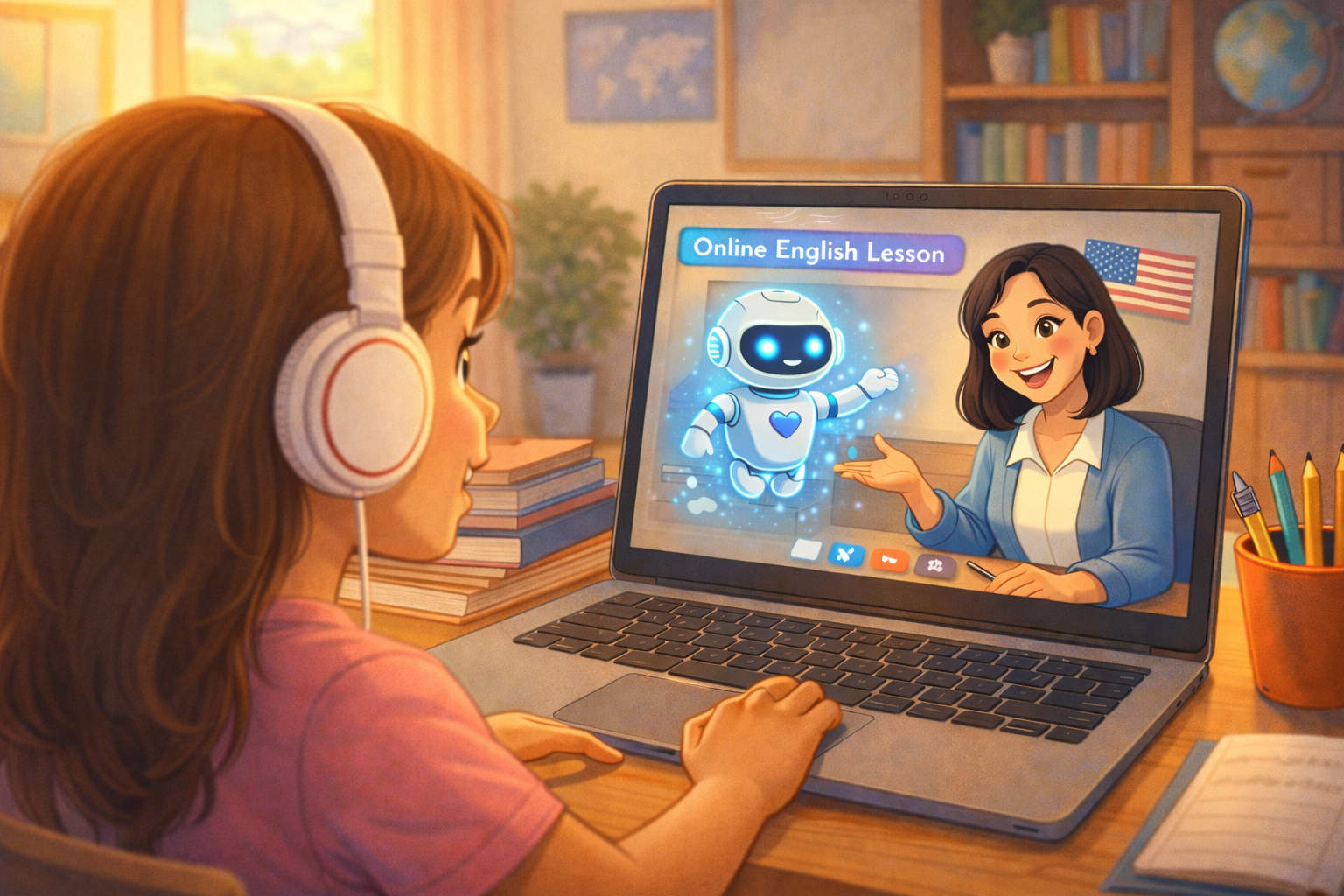
In theory, algorithm education offers perfect personalisation: adaptive exercises, instant corrections, and endless practice. In practice, teachers see clear limits. In the survey, around 64% preferred mostly individual lessons, while about 34% chose a blended format. The reason was consistent across continents: progress depends on teacher-student interaction, not just on optimised content delivery.
Teachers emphasised that education is not about processing speed, but about building confidence. For non-native English speakers, speaking up is an emotional challenge on its own. One teacher described progress as the moment children “start using words and phrases on their own,” something algorithms cannot replicate.
Across dozens of open responses, teachers described the same risk: excessive dependence on AI makes students passive. 32% of the teachers explicitly warned that children become “lazy and less independent” when apps lead the process. Instead of experimenting, they wait for answers. Instead of speaking, they observe. This pattern likewise reinforces bad social skills, especially in shy children who are already hesitant to communicate.
Human teachers respond to things algorithms cannot measure: tone, hesitation, mood, and fear of mistakes. They adjust in real time, rephrase questions, slow down, or gently push forward. This is where teacher-student interaction becomes the core of learning, not a bonus.
What teachers observe daily is mirrored in current research on artificial intelligence and language learning. Multiple recent studies show that AI tools can support vocabulary practice, pronunciation, and repetition, particularly for short-term engagement. But they also highlight the same limitation teachers describe: without guidance, motivation drops, and learning becomes shallow.
A large-scale analysis published in Frontiers in Psychology showed that AI-supported tools can improve test performance and self-regulated learning, but only when teachers structure and monitor their use. Another review indexed in PubMed reached a similar conclusion: generative AI helps informal practice, but sustained fluency depends on feedback, emotional support, and adaptive scaffolding—elements tied directly to teacher-student interaction.
Research and classroom reality agree on the same conclusion: technology amplifies learning only when human teaching is already present.

When teachers talk about progress, they don’t talk about scores. Most of the survey responses pointed to increased speaking confidence as the clearest sign. Others mentioned children forming full sentences independently, self-correcting, or volunteering ideas in conversation. These changes are gradual, although unmistakable.
Teachers also agreed on the structure. The most effective format was 20–30 minute lessons, 2–4 times per week, paired with short daily practice. Free tools help exposure, but around 70% of respondents said formal courses are still necessary for steady progress. This is where education vs. intelligence becomes visible: learning is not speed, but continuity.
For many non-native English-speaking families, this structure makes the difference between understanding English and actually using it.
Regarding the question of whether AI can replace English teachers, the response was clear. More than 64% of teachers said no—AI can only support teachers, not replace them. They pointed to the moments when human teaching matters most: calming anxiety, encouraging risk-taking, adapting to a child’s energy, and turning mistakes into curiosity.
AI tools were seen as useful for generating exercises or songs, and about 40% of teachers viewed this positively. But many also reported spotting AI use in homework immediately, due to unnatural phrasing or a mismatched level. While opinions varied on whether this counts as cheating, the consensus was clear: reliance on AI weakens learning.
This is the real risk behind the idea of AI replacing teachers—not that AI is too strong, but that children stop engaging. And a study published in ScienceDirect agrees: teachers and students said that generative AI cannot replace the human qualities that are essential for competency development and personal growth in education.
The strength of Novakid’s survey lies in its scale and diversity. Teachers work with children aged 4–12+, from diverse cultures and learning styles, and offer their understanding with unusual depth. They openly discussed weaknesses for a teacher, such as adapting to multiple learning speeds, but additionally emphasised that this flexibility is exactly what algorithms lack.
These are not opinions—they are repeated classroom observations. And they explain clearly why educators are important in any serious learning environment. Their patterns were consistent:
Again and again, teachers described the same moment: when a child stops being afraid to speak. That shift—from silence to participation—is driven by relationship, not software. It is the result of teacher student interaction, encouragement, and trust.
In a context increasingly determined by algorithm education, the message from both research and teachers is the same: artificial intelligence can support learning, but it cannot replace the human bond that transforms information into understanding. A learning experience for real is built between people, not systems.
Parents, trust wisdom over hype. See how Novakid brings together top teachers and smart technology for your child’s growth. Ready for real results? Book a trial lesson today.
Sources:
Will generative AI replace teachers in higher education? – Cecilia Ka Yuk Chan, Louisa H.Y. Tsi, 2024
Artificial intelligence in language instruction: impact on English learning achievement, L2 motivation, and self-regulated learning – Ling Wei, 2023
Artificial intelligence-based language learning – Hongliang Qiao, Aruna Zhao, 2023


The 5 C’s are commonly described as Communication, Collaboration, Critical thinking, Creativity, and Cultural awareness. Together, they support language use in real contexts, not just memorisation.
Key factors include learner motivation, exposure to English outside class, teaching quality, class size, emotional safety, cultural context, consistency of practice, and the level of teacher-student interaction.
A useful question is: “What should my child focus on next to make real progress?” It invites personalised feedback instead of generic advice.
An algorithm is a set of step-by-step rules or instructions used to solve a problem or complete a task. In education, algorithms are used to decide what content a learner sees next.
Based on current research and classroom practice, AI is expected to support teachers, not replace them. It lacks empathy, adaptation, and relational feedback that matter when human teaching is involved.
Understand your child’s emotions - find out about emotional intelligence for kids and learn to identify emotions for kids. Check out our ideas!

Fun memory games for kids help children improve memory development. Check out top 15 interactive memory games. Develop your kid's thinking skills now

Although the transition from private tutors to online education platforms was swift, parents had their time to decide how they felt about the opportunity to choose a teacher. The only question remains: how does one know the school is right for their kid, or they should change it?
How do you teach kids to read so that they don’t lose interest and make it effective at the same time?

How to teach time management? Find out Top 10 daily time management ideas for kids. Help your kid with development of time management skills.
Interactive games, role-play, songs, repetition, storytelling and much more! Find out which teaching methods work best for teaching English to children online.
We and our partners use cookies and similar technologies to improve your experience, personalize content and ads, and analyze our traffic. By clicking ‘Accept all’ you agree that your personal data and cookies may be used for ad personalization, including sharing with Google. For more information, read our Privacy Policy and Google’s Privacy & Terms.
You can personalize your choices by clicking on ‘Cookie settings’.
Find more information about what cookies are and how we work with them in our Cookie policy and Privacy policy
Strictly necessary
Advertising
Analytics
Personalisation


