




You may watch your child in their online English lesson and think, ‘Why does it take a teacher this long to cover a topic? Why do they repeat the same thing over and over again?



Many learners are faced with the greatest roadblock in learning English, and that is learning advanced English grammar. There are so many challenging grammar concepts that need to be studied to be fluent. But where to start?
One of the many reasons that English grammar can be intimidating to learn is that the rules are nonexistent in the child’s native language. Navigating such a challenge requires further study and help from the parent. There are many things in English grammatical rules that need to be focused on:
How to learn English at an advanced level? Learning the advanced English grammar rules will help you take your English skills to a higher level. Below are ten:
1. Articles – these are the small, inconspicuous words that appear before nouns. They help identify if the noun is non-specific (indefinite a/an) or specific (definite the).
Here’s the simple rule that anyone can follow:
Indefinite a/an: before singular nouns, or first-mentioned items.
For example: ‘a pen,’ ‘a cat,’ ‘a man’
Definite the: before a singular or plural noun, usually used when the noun is mentioned before
For example: “I’m using the pen I borrowed from you.” “The neighbour’s cat is so adorable.” “That man sitting next to you is the mayor.”
2. Prepositions – these are also small words or phrases but they are crucial for clear communication, and they show relationships of time and of location.
Here are some useful examples:
Prepositions of Time:
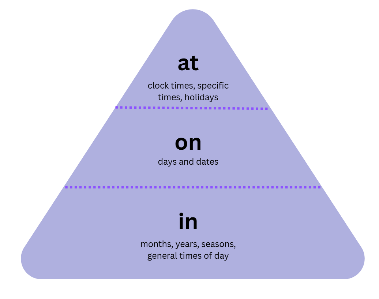
For example:
a. at 7 o’clock, at Christmas
b. on Sunday, on 1st December, on my birthday
c. in July, in the summer, in the afternoon, in the 2020s
We also use ‘in, on, at’ to talk about location. They go before nouns.
We use in to talk about something inside a space, like a box, a room, a house, a city, a country, and other physical locations.
For example:
a. My grandmother was born in Italy.
b. I forgot my coat in the house.
c. There’s a new shopping centre in town.
We use ‘on’ to talk about things touching a surface, whether vertically or horizontally. It can also be used to talk about floors in buildings or public transport.
For example:
a. That clock on the wall stopped working.
b. The dog is sleeping on the sofa.
c. My office is on the third floor.
We use ‘at’ to talk about a specific place or point for a specific activity.
For example:
a. Please wait for me at the entrance.
b. My sister is at work.
c. I saw your brother at the party!
3. Verb Tenses – This grammar concept is one of the most complex in the English language. We use tenses to show when an action took place and how long it lasted. Here are the four main tenses:
| Verb Tense | Meaning | Example |
| Past Simple | use to talk about things that occurred in the past. | I watched TV last night. |
| Present Simple | use to talk about basic facts or a habit. | I watch TV every night. |
| Present Continuous | use to talk about an ongoing or unfinished action | I am watching TV now. |
| Future Simple | use to talk about actions that will happen later | I will watch TV tomorrow. |
4. Conditionals – talking about possibilities or hypothetical situations requires special grammar rules. Here are the four main types:
| Types | Use | Structure | Example |
| Zero Conditional | Universal truths or general facts | If + Present Simple, Present Simple | If you heat ice, it melts. |
| First Conditional | Real or possible future events | If + Present Simple, will + base verb | If you eat healthy food, you will feel better. |
| Second Conditional | Unreal or unlikely scenarios | If + Past Simple, would + base verb | If I had more time, I would watch more movies. |
| Third Conditional | Unreal or hypothetical situations in the past (mostly regret) | If + Past Perfect, would have + Past Participle | If we had arrived earlier, we wouldn’t have missed the show. |
5. Subject Verb Agreement – this rule requires the subject to match its verb in number.
Have a look at the key rules:
a. A singular noun takes a singular verb
A bird flies to its nest.
She gets up at 7 o’clock.
b. A plural noun takes a plural verb
The birds fly up to their nests.
They get up at 7 o’clock.
c. Compound subjects joined by ‘and’ take plural verbs
My pen and notebook are in my bag.
John and Tom eat their breakfast.
d. Indefinite Pronouns take singular verbs (e.g., everyone, no one, someone, each)
Everyone is happy at the party.
e. Collective Nouns take singular verbs (team, family, committee, group)
My family goes to the cinema every Saturday.
6. Subject-Verb-Object – this is the standard structure in the English language.
Subject ➡️ who or what does the action
Verb ➡️ the action
Object ➡️ who or what receives the action.
Examples:
I (S) drink (V) tea (O).
The children (S) played (V) video games (O).
My mum (S) cooks (V) breakfast (O).
7. Adjective before noun – adjectives modify the noun, and in English, they usually come before nouns, except when a verb separates the adjective from the noun.
Examples:
I read an interesting (A) book (N).
My sister gave me a delicious (A) cake (N).
When a verb separates the adjective:
The book (N) was (V) interesting (A).
My grandma (N) became (V) sleepy (A).
8. Order of Adjectives – to sound more natural, it is also important to follow the specific order of adjectives (OSASCOMP). Look at the examples below:
| Opinion | Size | Age | Shape | Colour | Origin | Material | Purpose |
| Beautiful | Big | Old | Round | Red | American | Wooden | Running |
| Cheap | Tiny | Young | Square | Green | German | Plastic | Shopping |
| Disgusting | Tall | New | Long | Blue | French | leather | party |
Example sentences:
An old, wooden desk.
A nice, red party dress.
A durable, huge shopping bag.
9. Capitalisation and Punctuation – an English sentence will not be grammatically correct if it doesn’t follow the right capitalisation and punctuation rules. Proper capitalisation allows readers to understand the beginning of a sentence, and to determine which ones are the common and proper nouns. Correct punctuation allows sentence clarity and the cohesiveness of ideas.
Here are some of the capitalisation rules:
a. Start of every sentence.
b. Proper Nouns – they are the formal names of people and places, names of days and months, and holidays.
c. Pronoun “I” is always capitalised.
d. Not capitalised: seasons, common names (not the formal names, examples, teacher, sister, animals, city, country)
Look at the example sentence:
My sister’s name is Beth, and her birthday is on August 24.
The “M” in My is capitalised because it’s the start of the sentence, “s” in sister isn’t capitalised because it’s a common noun, whereas “B” in Beth is capitalised because it’s a proper noun. Also, “A” in August is capitalised because it’s the name of the month.
Here are some of the punctuation rules:
Look at the example sentences:
My favourite movie is showing tonight. (Statement)
Is it going to rain? (Interrogative)
That was scary! (Exclamatory)
In this recipe, I only used eggs, flour, water, and a little salt. (List of items)
10. Phrasal verbs – these are combinations of a verb and a preposition or an adverb, which create a totally different meaning from the original verb. Many idiomatic expressions are composed of phrasal verbs and knowing them will take your English skills to a higher level.
Here are the two types of phrasal verbs:
a. Separable (the verb and particle can be separated)
‘call off’ – to cancel
‘turn on/off’ – to switch the button on or off
‘take off’ – to remove
Examples:
‘They called the meeting off.’
‘Please turn the light on.’
‘Take your dirty boots off.’
b. Non-separable (the verb and particle can’t be separated)
‘call for’ – to require
‘come across’ – to find
‘look after’ – to take care of
Examples:
‘The council calls for a meeting.’
‘I was in an antique shop when I came across this interesting lamp.’
‘Can you look after my dog while I’m gone?’
Learning and overcoming those difficult topics in grammar can be daunting. However, it isn’t impossible. Through constant exposure to English media, everything will sound familiar.
First, you have to learn in context. Memorising those heavy concepts isn’t as effective as reading books, watching movies, and listening to podcasts.
Next, be consistent. Instead of studying sporadically, with long rests in between, there will be a tendency for you to forget what you learned. Instead, have short but frequent study sessions. There are some free online grammar apps that can help you, and of course, always take down notes. Use charts to help visualise verb tenses and colour-coded tables to help you with adjective order. Abstract grammar concepts will be easily understandable through colourful visuals.
Finally, find a study buddy. Learning alone can be lonely and sometimes boring. Having a study buddy will not only make studying English grammar less lonely, but you can also brainstorm together and teach each other!
High school students are more independent learners. Therefore, parents can just guide them through the process. For example, help the student find the right materials to learn. There are many free websites that offer PDF-ready exercises, too!
Find quality English books as reference materials. If not available, you can find print-ready reading materials online. From there, you can use different engaging techniques to help high schoolers learn grammar at home.
Focus on contextual grammar. Worksheets can be boring; instead, teach the grammar found in the texts in the books. For example, you can teach capitalisation and punctuation in the texts. You can also find lots of commonly used phrasal verbs in reading materials.
But most of all, keep learning simple and embrace mistakes!
NovaKid integrates grammar in both reading and writing. You can practise your grammar skills with professional teachers and take your English to an advanced level. Why don’t you try and book a free trial class now?


You may watch your child in their online English lesson and think, ‘Why does it take a teacher this long to cover a topic? Why do they repeat the same thing over and over again?

Can a foreign language change a personality? To find out the answer, Novakid online English school has investigated various phenomenons of bilingualism and some curious research on the topic. Find out more on our blog!
We and our partners use cookies to improve your experience, personalize content and ads, and analyze traffic. By clicking 'Accept all', you agree to our use of cookies in accordance with the Cookie Policy.
You can personalize your choices by clicking on 'Cookie settings'.
We use four types of cookies on our website. You can learn more about cookies and how we use them here: Cookie Policy
Strictly necessary
Advertising
Analytics
Personalization