




Children easily remember long verses and sing them skillfully, imitating the intonation without even fully understanding the content and lyrics. How do they do it? It’s a mystery!

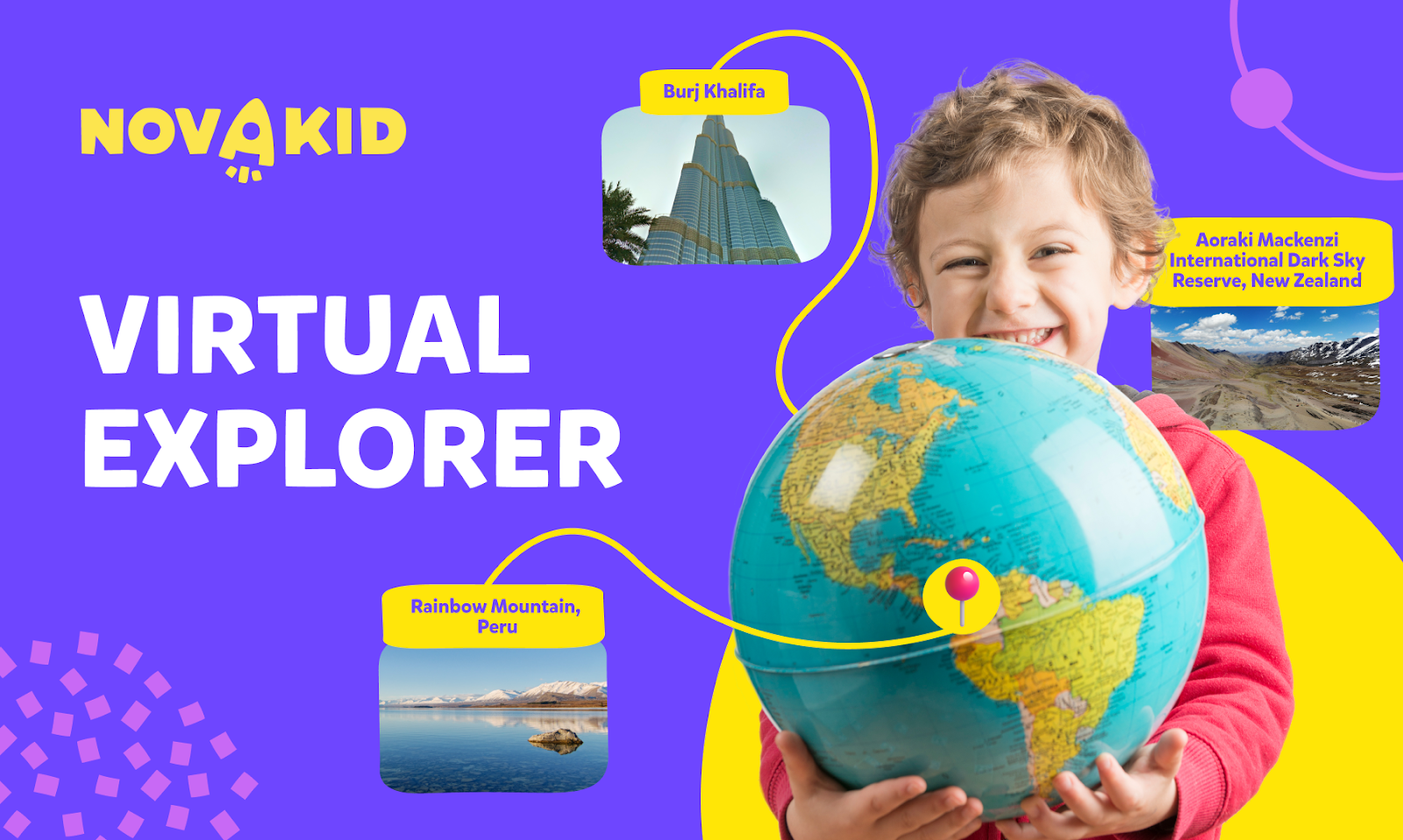

Novakid is excited and proud to present its most interactive and most advanced level to the family: Virtual Explorer!
This level, which bridges the A2 and B1 levels of the Common European Framework of Reference (CEFR), features over 100 beautifully designed immersive lessons.
As with our previous English programmes, students learn and practise new vocabulary and grammar in a fully immersive environment and they’ll take their reading skills to the next level with a series of rich texts to absorb and discuss.
Students who have studied previous levels at Novakid will already have enjoyed regular classes devoted to Content and Language Integrated Learning (CLIL). In Virtual Explorer, we extend this strategy by giving every single lesson its own theme.
In tandem, we introduce a focus on Higher Order Thinking Skills (HOTS), which students develop through a series of rich and engaging topics. HOTS build on students’ existing language skills and ways of thinking by encouraging creativity, evaluation and analysis.
These are invaluable life skills that they will have the opportunity to practise and develop while strengthening their core linguistic skills.
Higher Order Thinking Skills are fantastic for a student’s growth because they can adapt these skills more effectively to situations and contexts beyond the classroom.
Virtual Explorer is a diverse level that follows the Communicative Approach, so students develop their communication skills in a range of different ways.
They get creative and innovative in the areas of art, music and city planning. They celebrate human achievements in a wide range of fields including sport, literature and exploration. They make real-life choices, which exercise their decision-making skills. They participate in open dialogue that fosters active listening skills.
Although the level is packed with complex and stimulating texts, we do so much more than impart information. We give the student space to go deep into the material and develop an understanding beyond what is explicitly presented.
In every lesson, students visit at least one virtual reality slide powered by Google Street View. The slides consist of 360-degree photographs, where our students can virtually step into the world they’re learning about: unique, often breathtaking places!
One great benefit of virtual reality in education is total immersion in the world you’re learning about – which is excellent for retention.
A student will leave each lesson having read about, discussed and explored a place, time in history or a topic that may have been new to them in an interesting, engaging manner.
Find out more about the Virtual Explorer course and how Novakid is using virtual reality in education in this article!
Did you like the article?


Children easily remember long verses and sing them skillfully, imitating the intonation without even fully understanding the content and lyrics. How do they do it? It’s a mystery!
This article shows how to motivate kids to learn English in a friendly way, using stories and video games

4 new English lessons await our young travellers on the Virtual Explorer course at Novakid.

Discover how English songs, cartoons, and games help children learn faster. Explore fun and effective ways of learning English for children through play, music, and interaction.

The key objective of learning English is to be able to comprehend speech and make yourself understood in English. At the same time, it is mistakenly assumed that the key to comprehension is sufficient knowledge of vocabulary and grammar.
The word “gamification” has become very much part of our lives. New educational programmes incorporating games are fun for children and encourage them to continue their studies.
We and our partners use cookies to improve your experience, personalize content and ads, and analyze traffic. By clicking 'Accept all', you agree to our use of cookies in accordance with the Cookie Policy.
You can personalize your choices by clicking on 'Cookie settings'.
We use four types of cookies on our website. You can learn more about cookies and how we use them here: Cookie Policy
Strictly necessary
Advertising
Analytics
Personalization