




Motivation is the key to learning any language; a 5- or 10-year-old may experience age-specific troubles. With a teacher who fails to motivate, English is lost on a kid.


Your child is using Chatgpt to do their homework and you are not sure what to do. Is it cheating? Or is it a tool he should learn to use? To understand this better, we asked 130 Novakid English teachers in different countries what they think about children using AI in education. Here’s what they told us.
The short answer is: it depends. If children use AI to do their homework instead of them, then yes, it is a problem. In that case, they’re not really learning. But if they use AI as a tutor—to help them understand a difficult maths problem or quiz themselves on the French Revolution—the situation changes completely. Used this way, AI is not cheating.
Used correctly, AI can act like a personal tutor. AI can explain concepts in a clearer way, answer questions, check understanding, and help children learn more independently. Let’s take a closer look at the pros and cons of AI in education, according to Novakid teachers, and how to teach your child to use AI the right way.
First of all, our teachers believe that homework is important for learning. We asked: Can a child learn English without doing homework? And 81% of our teachers said that homework is necessary to learn English. At Novakid, homework is always assigned after a class, but it does not require pen and paper—only interactive activities and online games. So kids don’t even realize they are doing homework.
Having established that homework is important, we then asked our core question:
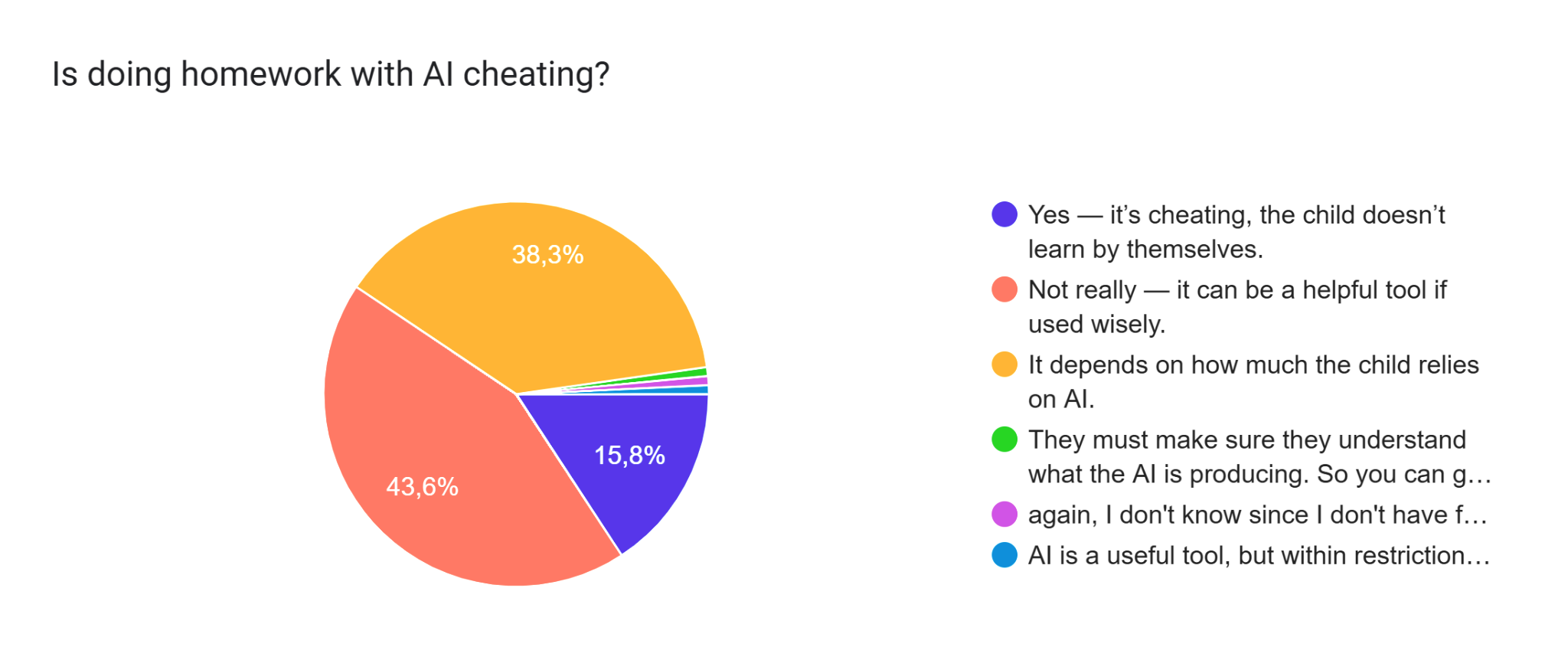
Is doing homework with AI cheating? Only 15% of Novakid teachers answered with a clear yes. The vast majority think that AI can be a tool and that it depends on how it is used.
The answers were far from black and white. The largest group said “Not really—it can be a helpful tool if used wisely”, while a significant number chose “It depends on how much the child relies on AI.”
What comes through very clearly is that how AI is used matters more than whether it’s used at all. Many teachers explained that AI can support learning—as long as it doesn’t replace thinking. One teacher put it this way:
“It is crucial that children still practice critical and analytical thinking skills, which can otherwise be replaced by AI. If there are restrictions on using AI for homework—such as using it only for research purposes and not to fully answer the questions—then I think it is fine.”
Another teacher highlighted the importance of understanding, not just copying:
“They must make sure they understand what the AI is producing. You can use AI to find a word, but then make sure you understand it.”

If AI does all the work, learning stops. That’s why so many responses came back to the same idea: AI is fine as support, not as a shortcut. Using AI isn’t cheating if it helps a child learn, think, and understand. It becomes a problem only when it replaces effort, curiosity, and independent thinking.
Different prompts lead to very different learning outcomes. If a child asks: “Write a 300-word essay on climate change.” or “Solve this maths problem.” they are asking AI to do the work for them and very little learning happens.
Prompts like: “Explain why this answer is wrong”, “Quiz me on climate change based on this text.”, “Explain this in a simpler way.” use AI as a learning support. The child is still doing the thinking and AI acts more like a tutor than a shortcut.

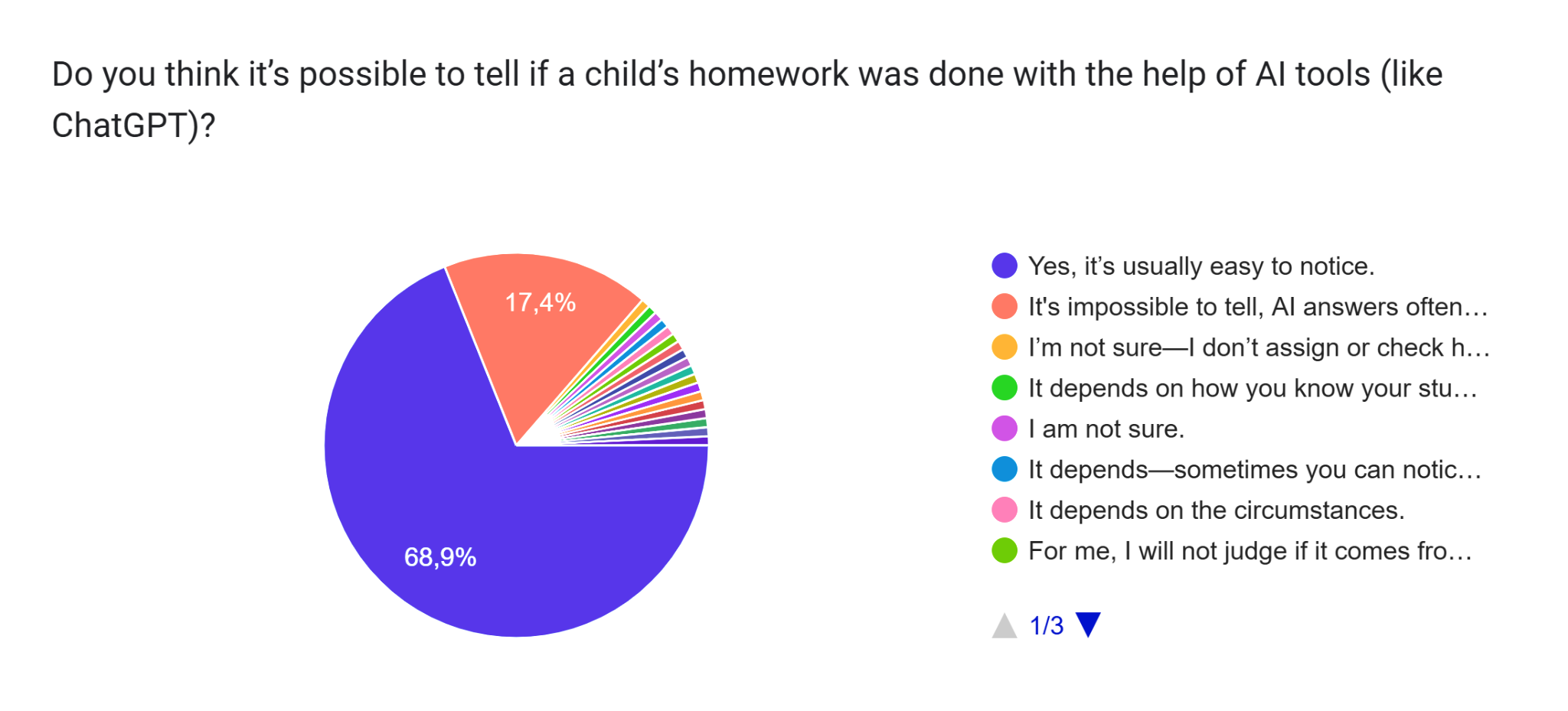
We asked teachers if they could tell if a child used AI in their homework. And yes, according to nearly 70% of teachers, it’s usually possible to notice when homework was done with the help of AI. Teachers often recognise it when the language sounds too perfect or very different from a child’s usual level.
But when we look at the teachers’ comments more closely, one message comes through very clearly: that’s not what really matters. What counts most is whether the child has actually learned something. As one teacher shared:
“For me, I will not judge if it comes from AI work or not. What matters is whether the child is really learning.”
Another teacher pointed out that real learning shows up beyond homework, for example when teachers ask follow-up or personalised questions and see how a child uses English in class.
In other words, even if teachers can often tell when AI is being used, the focus with children shouldn’t be on catching them, but on progress, understanding, and confidence. Homework is just one piece of the puzzle, and real learning happens when children can listen, understand, and use English for meaningful, real-life communication.

When asked if AI is good or bad, and about the role of artificial intelligence in education, most Novakid teachers see it as a positive opportunity, as long as it’s used in the right way.
In fact, 51% of respondents said that AI “expands the ways of learning and creates new opportunities”. Many teachers described AI as a helpful tool that can make learning more engaging, creative, and flexible.
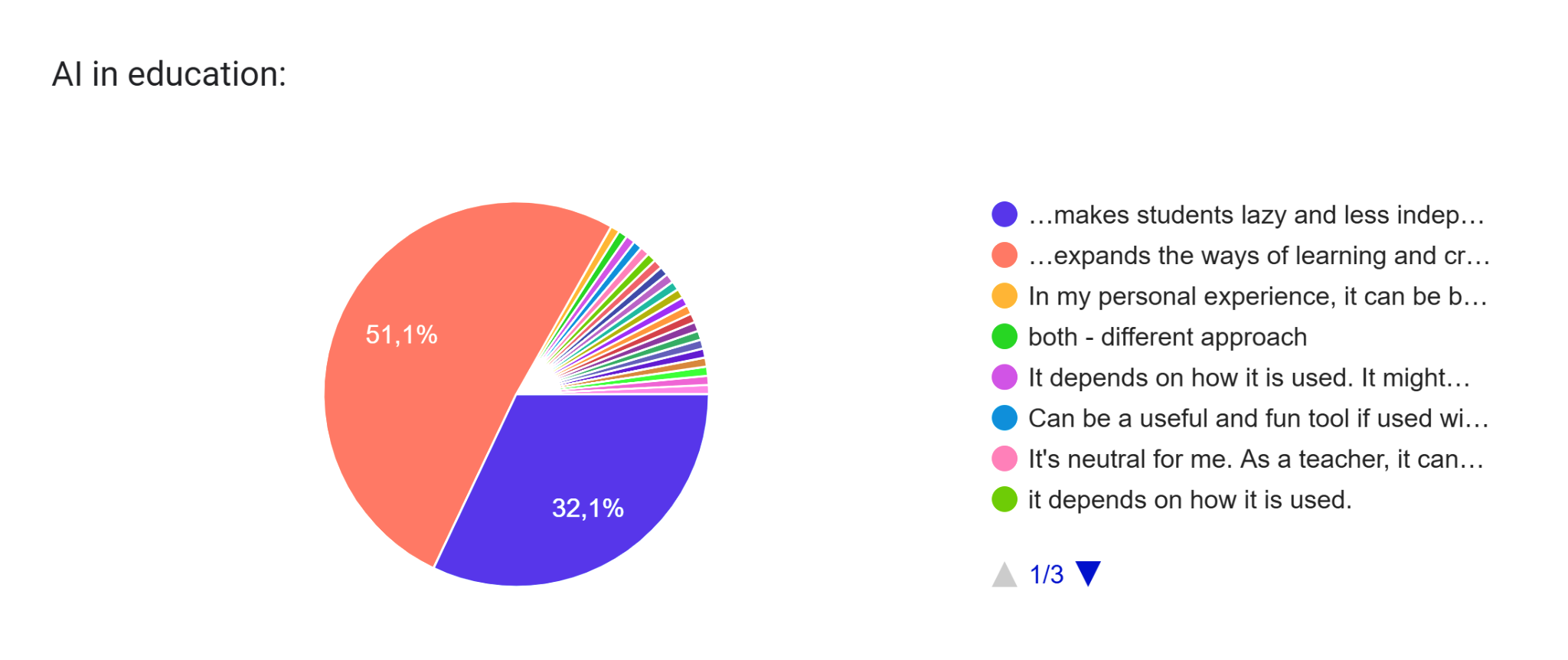
At the same time, a significant number of teachers also expressed concerns. Around one third of respondents (32,1%) felt that AI can “make students lazy and less independent” if it’s overused or used without guidance. One teacher summed it up well:
“It can be beneficial if used judiciously, but overreliance can foster dependency.”
What emerges from the teachers’comments is a balanced view. Many teachers explicitly said that AI has both pros and cons and that its impact depends on how it’s introduced and supported. Some highlighted the importance of guidance, especially with children:
“If students were provided with the proper way to use AI, it would be a great help.”
Overall, teachers don’t see AI as good or bad by default. They see it as a tool that can help children learn more, feel more confident, and stay curious, as long as it’s used with guidance, balance, and a strong focus on real learning.
To come back to the question we started with: yes, you can let your child use AI when doing homework, as long as it helps them learn rather than do the work for them. Here are a few smart, teacher-approved ways children can use AI while still doing the thinking themselves.
AI can ask questions, correct answers, and help with pronunciation and grammar. It can be a valuable tool when learning languages. But it cannot replace a human teacher. Learning is not a solo activity, it happens through interaction. Children learn best when they feel seen and motivated, and this comes from a relationship with a teacher who supports and inspires them.
Discover how Novakid English teachers help children feel confident and motivated about learning English. Book a free trial lesson and let your child experience English with a native-speaking teacher on our interactive platform.


Motivation is the key to learning any language; a 5- or 10-year-old may experience age-specific troubles. With a teacher who fails to motivate, English is lost on a kid.


See what 130 teachers say about how to track your child’s progress in English and how to set realistic expectations for learning and fluency.

Learn how the time your kid spends on screen can be used as an advantage for learning English. Find out our tips for bilingual English education.
Learn what Total Physical Response (TPR) is, how Novakid teachers use it in class, and why this teaching approach supports English language learners through movement and communicative language teaching.
New learning tools, digitalization, flexibility and accessibility – all this has become key to bringing education to a fundamentally new level.
We and our partners use cookies and similar technologies to improve your experience, personalize content and ads, and analyze our traffic. By clicking ‘Accept all’ you agree that your personal data and cookies may be used for ad personalization, including sharing with Google. For more information, read our Privacy Policy and Google’s Privacy & Terms.
You can personalize your choices by clicking on ‘Cookie settings’.
Find more information about what cookies are and how we work with them in our Cookie policy and Privacy policy
Strictly necessary
Advertising
Analytics
Personalisation


