



How to help a child to come back to school routines? A psychologist Gülizar Şehitoğlu shared with Novakid online English school her tips to make the first school weeks smooth and exciting for a child and families.


With ChatGPT and so much English content available online, many kids are learning English on their own, without formal ESL classes. Is it still worth paying for English lessons? The short answer is yes. Even though there’s an enormous amount of free content online, traditional English courses — whether one-to-one or group classes — are still hard to replace. This is also confirmed by a survey of over 130 NovaKid English teachers.
The key point is that access to content alone isn’t enough. Having lots of materials doesn’t automatically mean knowing how to use them effectively to truly learn a language. Learning English without a course is like having a Lego set without instructions: all the pieces are there, but without guidance it’s hard to use them effectively. A teacher provides direction by choosing the right resources and supporting the learner where they need it most.
Moreover, language learning is mainly about communication. Kids study English to speak, express themselves, and interact with others — and real communication requires at least two people, ideally two humans. An English course guarantees this kind of guided, real interaction, which is difficult to recreate by using isolated tools on your own.
On top of that, real progress requires consistent practice, a clear structure, routine and motivation. Learners need a path that combines grammar, exercises, and homework in a way that’s engaging and enjoyable, while supporting them step by step. All of this comes together naturally in a well-designed group or one on one English classes for kids.
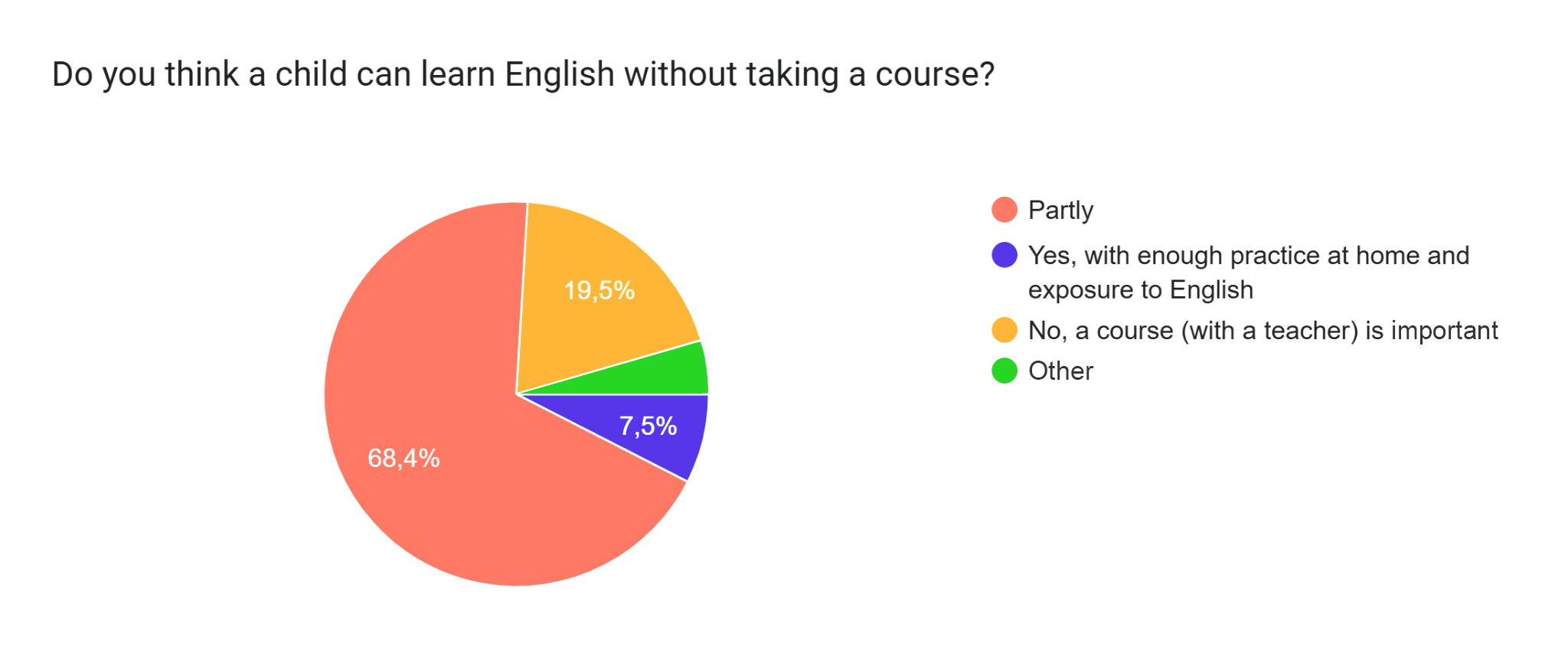
We asked over 130 NovaKid English teachers whether a child can learn English without taking a course. The answers were clear: almost 20% said it’s not possible at all, and more than 68% believe that, at best, children can only learn the basics on their own.
Many teachers agree that exposure to English at home can be helpful. Watching videos, cartoons, or listening to songs in English certainly improves listening skills, pronunciation, and vocabulary. But on its own, it’s not enough. As one teacher explained, the best results come from having structured lessons, a clear routine, and a certain level of discipline in learning.
“Structured lessons that establish a disciplined learning routine seem to yield the best results.”
— NovaKid teacher

Another teacher put it very directly: without a course, key elements are missing, such as “proper input, guidance, monitoring, and assessment from certified educators.” In other words, there’s no one to confirm whether a child is on the right track or show them how to improve.
That’s where an English course really makes the difference. It’s not just about “doing some English,” but about learning it consistently, with clear goals and a path designed for the child’s age and level. A course creates habits, provides structure, and helps make English a regular part of a child’s routine instead of something left to chance.
So yes, exposure to English is a great starting point and should absolutely be encouraged. But to truly learn a language — not just recognize words or sounds — something more is needed. And that “something more” is exactly what a well-designed English course can offer.

The English language is best learned through communication — by using it in everyday conversations and making it a habit. – Novakid teacher
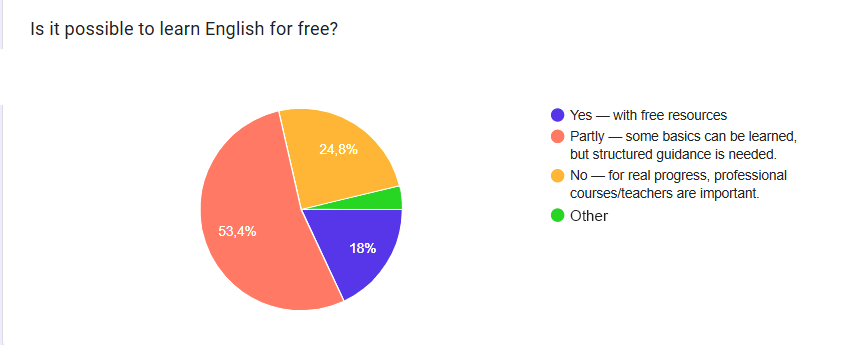
A very similar question is whether it’s possible to learn English for free. We asked NovaKid English teachers, and their answers were quite clear. More than half said that no, you can’t really learn English without investing in a structured learning path, while many others believe it’s only partially possible. Overall, nearly 80% of teachers agree that free resources may help learners pick up the basics, but real progress is unlikely.
One response stood out in particular: a language is learned through communication. English is learned by using it, making it part of everyday life, and turning it into a habit. But reaching that level of real, active use — especially if you don’t live in an English-speaking country — usually requires lessons.
Of course, there are many useful free tools available today. You can practice conversations with ChatGPT, do exercises, or clear up doubts. All of this helps and can be a valuable support. But, as one teacher clearly stated:
“AI can never be teachers. They are robots with no empathy or emotional connection which can motivate students to learn.”
And it’s exactly that empathy, together with real human connection, that truly motivates students to learn. Language learning, like any other kind of learning, is a shared process between teacher and student. Progress doesn’t depend on just one of them, but on the relationship built on trust, interaction, and mutual motivation.
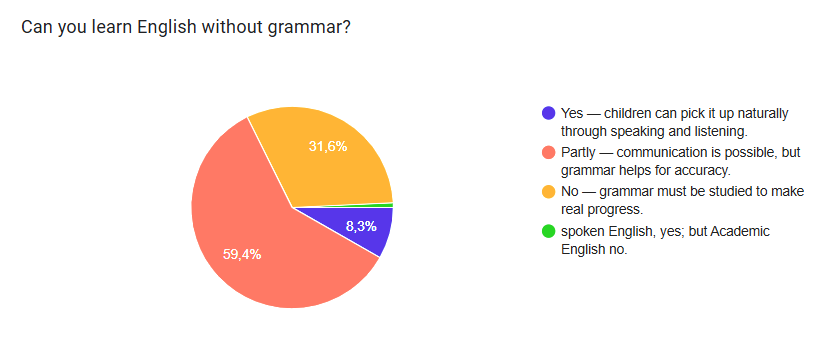
Another key topic is grammar. Exposure to English — through videos, apps, or even ChatGPT — definitely helps learners become familiar with the language. But on its own, it’s not enough, especially if you don’t live in an English-speaking country. To make real progress, learners also need structured grammar practice: over 90% of the teachers in our survey believe that English can’t be learned without grammar.
The question is: would a child really choose to do grammar exercises online on their own? In most cases, probably not. Without guidance, grammar tends to be skipped, rushed, or replaced with activities that feel easier or more entertaining. A course — and especially a 1 to 1 English class — makes sure grammar is introduced at the right time, explained in a clear way, and practiced consistently, without turning it into something boring or overwhelming. In Novakid, grammar is learned through interactive activities, games, and guided practice.
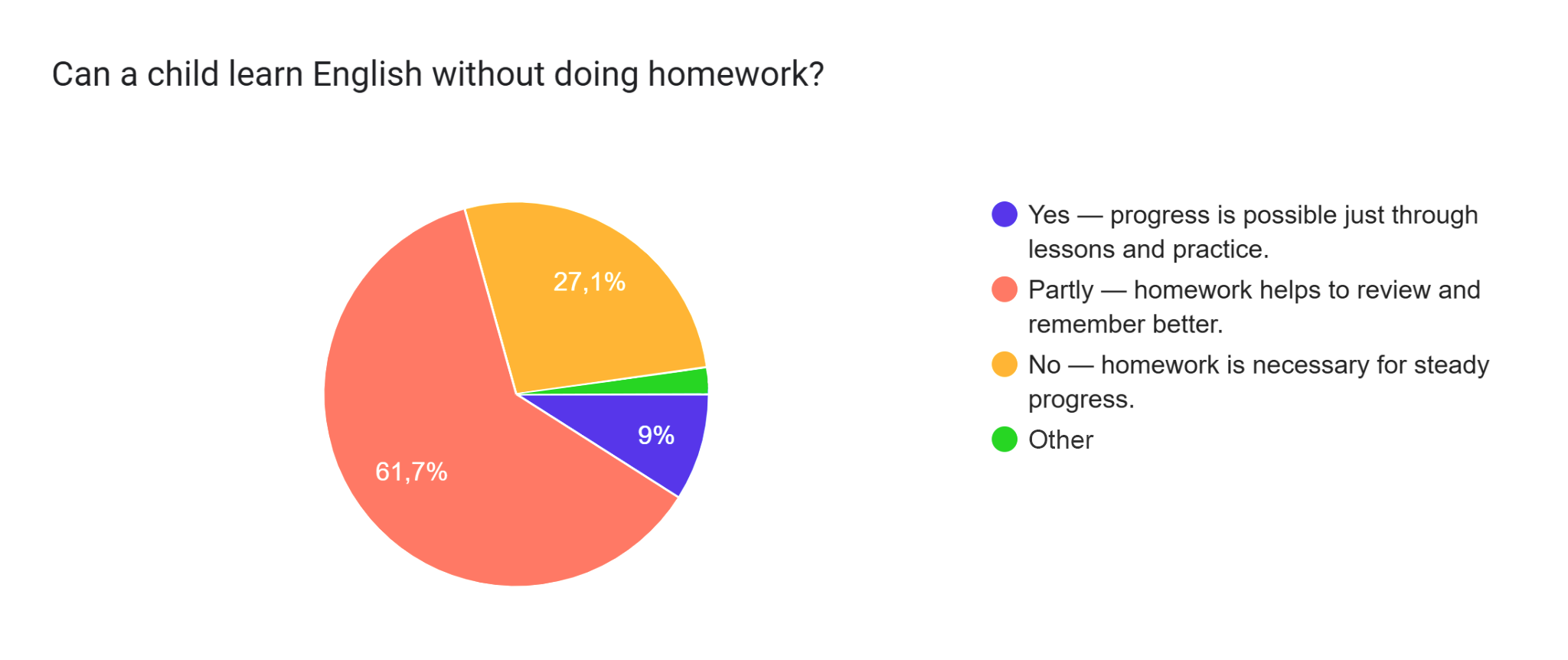
And after grammar comes homework. According to the survey, around 90% of teachers consider homework essential for learning. For 61.7%, progress without homework is only partial, while nearly 30% believe real progress isn’t possible at all without it.
Homework helps develop all four core language skills: speaking, writing, listening, and reading. Everyone is naturally stronger in some skills and weaker in others. Without guidance, learners tend to focus only on what feels easiest and ignore the rest. This is where 1 to 1 English lessons really make a difference: the teacher makes sure all four skills are practiced and uses homework to strengthen the areas where the student struggles most.
The good news? Homework doesn’t have to be boring. When it’s well designed, it becomes engaging, motivating, and even fun.
First of all, structure. 1 to 1 English tuitions or group English classes gives learning a clear structure. Lessons are scheduled, there’s a fixed appointment, and that naturally pushes kids to make time for English. When learning is left entirely to a child’s motivation, it often becomes irregular — whenever they feel like it. And without consistency, progress slows down.
Then there’s real personalization. AI tools can be helpful, but they don’t truly notice specific difficulties — for example, if a student keeps struggling with the present continuous. A teacher does. They spot recurring mistakes, understand where the learner gets stuck, and suggest exactly the right exercises at the right moment.
Finally, the human factor. This is something no robot can replace. A teacher knows when a student is tired, unmotivated, or just having an off day. They can change activities, add a bit of humor, lighten the lesson, or tell a personal story to make a grammar rule or spelling point easier to remember. That’s how curiosity and attention come back.
These aren’t small details — they’re essential to learning. Motivation, empathy, emotional awareness, and the ability to adapt to the person in front of you are what turn an English class into much more than a set of exercises.
Try a free NovaKid English class and see how a structured English course can help your child make real progress.


How to help a child to come back to school routines? A psychologist Gülizar Şehitoğlu shared with Novakid online English school her tips to make the first school weeks smooth and exciting for a child and families.
Modern methods of teaching a foreign language include a lot of unconventional approaches, especially when teaching English to kids. If you compare teaching kids to teaching pre-schoolers, it certainly seems unorthodox, because the principles and approaches are totally different.

There are many benefits of learning English language at an early age. Try English at an early age and understand the importance of learning English.

Speak English like a native speaker! Meet native English speaker, who will make you fluent in English. Improve your accent and pronunciation now!
From essential elements of high-quality lessons and practical planning tips to simple strategies to make English learning effective and enjoyable for your child - here are insights from a professional ESL teacher.

Learn ways to teach your child creative thinking. Develop creative thinking and find examples of creative activities for kids. Read the article!
We and our partners use cookies and similar technologies to improve your experience, personalize content and ads, and analyze our traffic. By clicking ‘Accept all’ you agree that your personal data and cookies may be used for ad personalization, including sharing with Google. For more information, read our Privacy Policy and Google’s Privacy & Terms.
You can personalize your choices by clicking on ‘Cookie settings’.
Find more information about what cookies are and how we work with them in our Cookie policy and Privacy policy
Strictly necessary
Advertising
Analytics
Personalisation


