




From essential elements of high-quality lessons and practical planning tips to simple strategies to make English learning effective and enjoyable for your child - here are insights from a professional ESL teacher.


The sound of the laptop keyboard tapping at 9 p.m., the subtle glow of the phone screen, and the soft-spoken “I’ll just ask AI for one more question about my English lesson”.
For many parents, homework AI has become the evening’s unseen companion, appearing when energy is low, patience is at a low ebb, and the only thing that matters is “getting it done fast”. But the problem isn’t homework AI itself. It’s what parents expect from it: instant answers, perfect results, and a way to bypass the hard but important work of learning.
In fact, the real issue isn’t technology’s ability to help kids with homework; it’s the way adult expectations around homework, results, and time have turned what should act as a brief extension of classroom learning into a nightly family project. The question “should kids have homework?” deserves a more nuanced answer than a simple yes or no. It deserves a conversation about what kind of homework, how much, and how AI fits into that as a tutor, not a ghostwriter.
Many parents resort to AI for homework. A child hands over a problem they don’t understand, the parent doesn’t remember or is unfamiliar with the topic, and the easiest move is to plug it into an AI chatbot or homework‑help app. Recent surveys of parents show that AI is increasingly used to explain concepts, check answers, or generate practice exercises.
Yet, in the same way children can overuse AI, so can parents. Instead of asking whether AI truly helps students learn, adults often ask whether it gets the homework done. The danger is subtle: when the primary goal is completion, not understanding, homework AI shifts from support to crutch and kills critical thinking. This isn’t AI’s fault. It’s the expectation that every assignment must be perfect, on time, and polished before the night ends.
Adolescents report using AI tools for schoolwork in large numbers; some studies find that roughly half of high school students rely on chatbots or AI helpers throughout the year. For many teens, the line between “help” and “cheating” is fuzzy; they see AI as a convenient way to get answers or to finish assignments faster. Parents, in turn, often feel pressured to ensure their child keeps up good grades, and social comparisons can push families toward excessive reliance on quick digital fixes.
The conversation about AI in homework can’t be separated from a bigger question: Does homework help students learn? The research paints a nuanced picture. Meta‑analyses of studies on homework suggest that homework can be associated with elevated academic achievement, but the effect is generally small, and it is stronger for older students than for elementary students.
For younger students, extra time on homework often does little to improve learning, especially when the tasks are repetitive or inconsistent with what the child actually needs to practice. It can even affect mental health. For older students, homework can play a somewhat supportive role, especially when it is targeted, meaningful, and connected to classroom learning. But even then, the gains for academic performance are modest and depend heavily on how the work is designed and how students feel about it.
Crucially, other research shows that how homework affects students goes beyond grades. Heavy homework loads are linked with stress, anxiety, sleep deprivation, and even family conflict. Studies from Stanford University and other institutions indicate that adolescents feel overwhelmed by the amount of homework, leading to emotional burnout and a sense that school consumes their entire lives. In this context, homework becomes less about learning and more about coping, another race to tick boxes rather than to understand.
These conclusions don’t mean homework should disappear from schools; they suggest that homework should be lighter, more focused, and more intentional. Excessive homework is not a good idea overall. Some schools and educators have begun experimenting with reducing or banning traditional homework, stressing that the benefits of no homework—like family time, creative play, and rest—can be just as important as the benefits of practice.
The question “why homework should not be banned” matters precisely because homework can serve useful purposes when it is well designed. Homework activities can help students consolidate what they’ve learned, practice skills, and build responsibility. It can also prepare students for the expectations of older grades and future work environments, where deadlines and independent tasks are part of the daily rhythm.
However, these benefits come with conditions. Homework is most effective when it is short, clear, and closely connected to what students are learning in class. Too much homework can be confusing, or repetitive, and that affects the learning process. It becomes something children do reluctantly just to please adults, not to grow their understanding.
On the other hand, in an output based education model, attention moves away from “how many assignments did you complete?” to “what can the student actually use this knowledge for?”. Instead of counting pages or hours, teachers ask: Can the student explain the concept? Can they apply it in a new situation? Can they solve a similar problem on their own?
This mindset changes the way homework is designed and experienced. Rather than piles of drills, students get short, meaningful tasks that target specific skills. Parents, in turn, shift from being “homework enforcers” to coaches who actually help children reflect on what they learned.


Given that homework AI exists—and that both students and parents use it—the question is not “should we allow it?” but rather “how should we use it?”. The answer many educators give is simple: AI should be a tutor, not a ghostwriter.
A good tutor:
When homework AI plays this role, it can support learning. A child can ask an AI:
These can be tools that extend the learning experience beyond the classroom walls.
The problem arises when AI becomes a ghostwriter—when students paste a full assignment and ask it to “just finish this” — and parents accept the result without questioning whether the child understands it. This is also where the distinction between homework AI and cheating becomes blurry. Studies of student attitudes show that many teens themselves see using AI to complete entire assignments as cheating, even if it is technically allowed under some school policies.
Parents, then, bear the responsibility for forming the norms around homework AI. Instead of asking, “Is this done?” they can ask, “Can you tell me how you solved this part?” and “Are you able to explain it to me?”. This small shift changes the culture of homework from a performance-driven to a process-driven one.
How much homework is too much? Teachers’ perspectives matter in this debate, and many align more closely with research than with the pressure parents feel. Novakid designed a survey for its English teachers worldwide to understand their positions as educators and how consistently they indicate that homework can be helpful. But what about when done with the help of AI?
The teachers reported that:
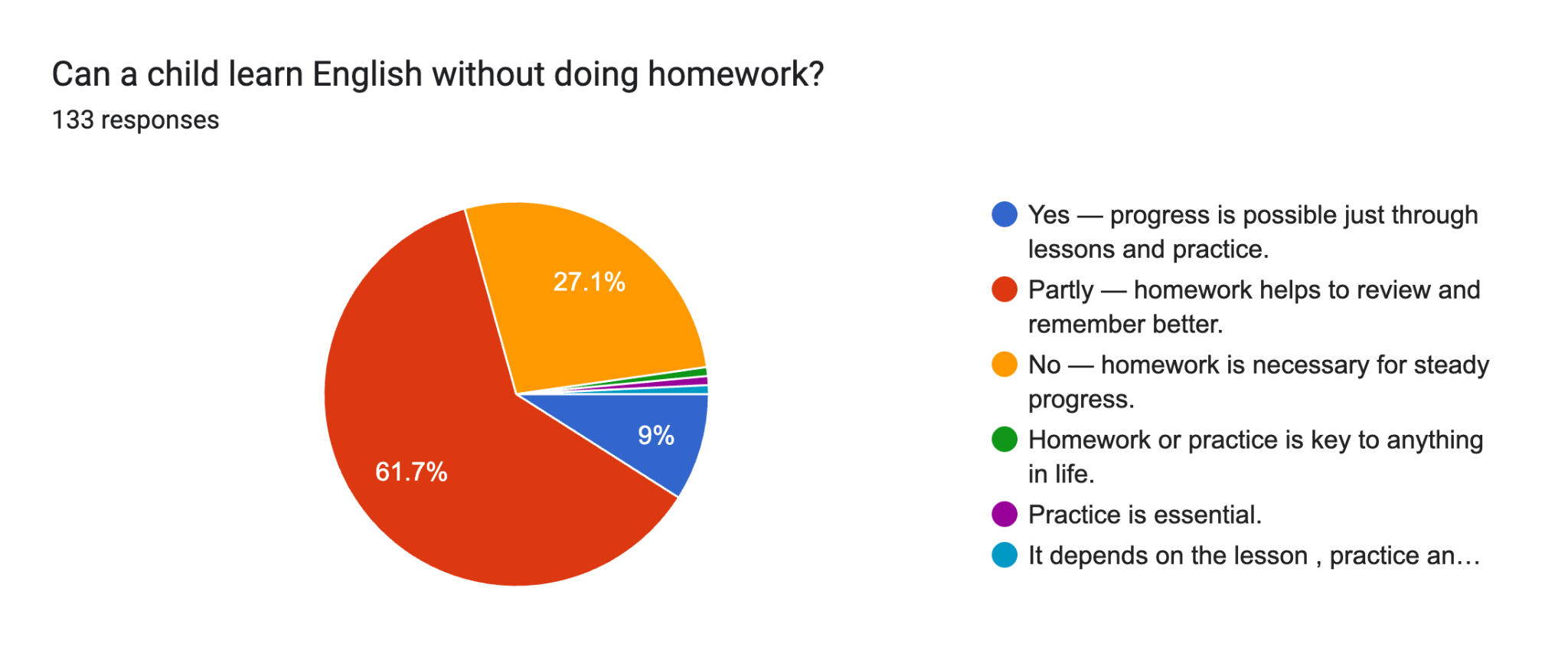
On the question of AI for English lessons homework, responses were mixed yet clear: some English teachers see AI as a neutral tool that can help students create cases or practice vocabulary; some fear that overuse makes students lazy and less independent. A few explicitly state that using AI to complete homework without understanding is a form of cheating, while others allow it within limits—as long as the child still engages with the material and reflects on the process.
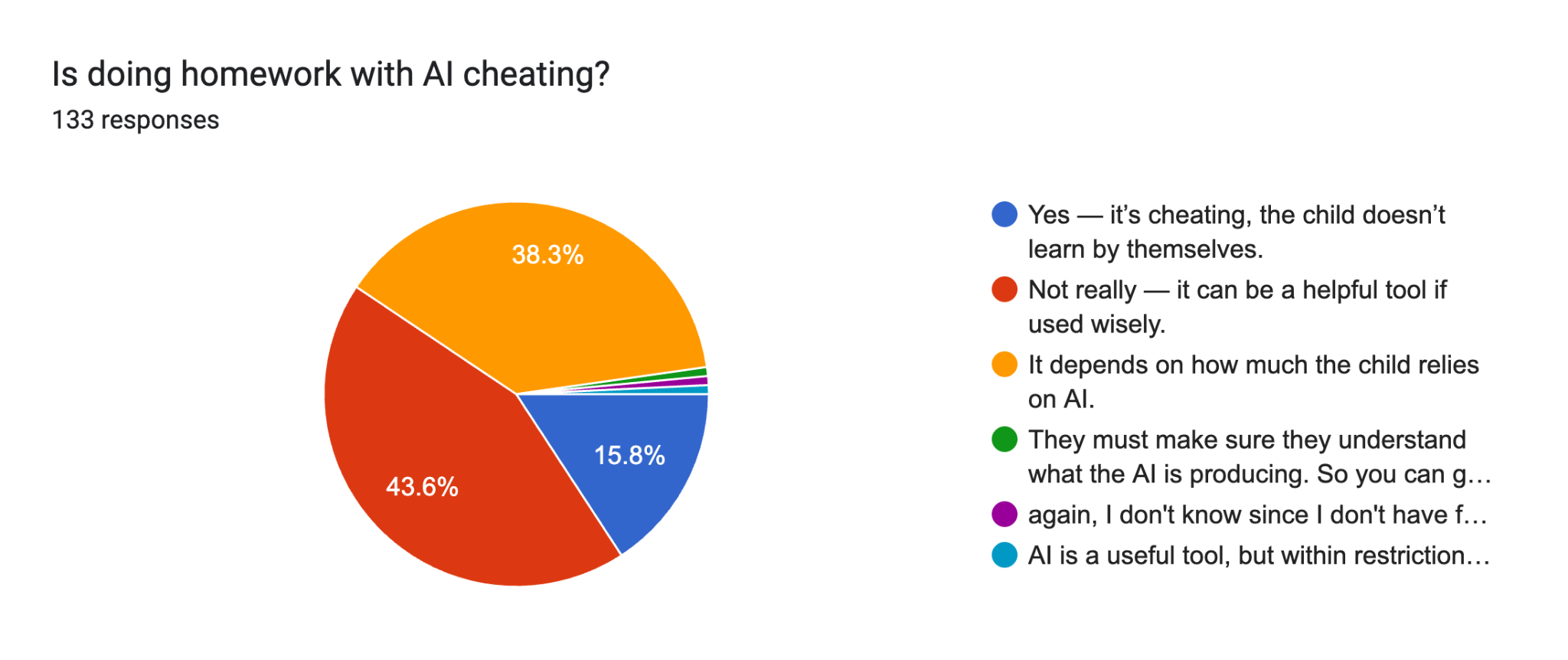
This divide is not surprising. It shows the wider tension in education today: educators want students to learn, not just to deliver. Parents, meanwhile, operate under different pressures—grades, exams, comparisons with peers—and can feel that any tool that makes homework “easier” is automatically good, even when it might be undermining learning in the long run.
The solution isn’t to ban homework and ban AI. It’s to lighten homework, reframe expectations, and use AI more thoughtfully. Parents can start by:
When homework is light, meaningful, and connected to real learning, and when AI serves as a helpful tutor rather than a ghostwriter, the whole family feels less pressure. The goal is not perfection on every sheet but growth, understanding, and confidence—the kind of learning that actually lasts.
Homework AI isn’t the problem. Parents’ expectations are for online English lessons and other topics. The real question isn’t whether AI belongs in homework; it’s whether homework is asked to do too much, and whether AI is being used to reinforce learning—or to shortcut it. What do you think?
Ready to find out more about how Novakid can be a solution for your kid? Book a trial lesson today!
Sources:
A Study on the Use of Artificial Intelligence to Reduce Parental Burnout During Children’s Homework Supervision in Coimbatore District – Dr. P. Natarajan, Ms. Renumahalakshmi (2025)
How Teens Use and View AI – Colleen McClain, Monica Anderson, Olivia Sidoti, William Bishop (2026)
What do AI chatbots really mean for students and cheating? – Carrie Spector (2023)
Homework and academic achievement: A meta-analytic review of research – Gökhan Baş, Cihad Şentürk and Fatih Mehmet Ciğerci (2017)
Nonacademic Effects of Homework in Privileged, High-Performing High Schools – Mollie Galloway, Jerusha Conner and Denise Pope (2013)
Survey: Most Teens Think Using AI for Schoolwork Is Cheating – Lauraine Langreo (2023)


The main problem is not the homework itself, but its volume, design, and expectations. When homework is too long, repetitive, or disconnected from what the child actually needs to learn, it stops being a learning tool and becomes a source of stress, conflict, and burnout.
Using AI for homework becomes problematic when it turns from a tutor into a ghostwriter. If children outsource thinking, reasoning, and writing entirely to AI—without understanding the steps or being able to explain their work—they miss the core benefits of practice and learning.
Homework causes stress for parents because it turns into a nightly family project: checking answers, explaining topics they may not remember, and trying to ensure everything is “done” and “correct”.
Parents feel both cautiously hopeful and worried about AI in education. On one hand, they appreciate that AI can help explain difficult concepts, generate practice exercises, or save time on routine tasks. On the other hand, they fear it might encourage laziness, reduce independent thinking, or create new forms of cheating.
From essential elements of high-quality lessons and practical planning tips to simple strategies to make English learning effective and enjoyable for your child - here are insights from a professional ESL teacher.
How to teach time management? Find out Top 10 daily time management ideas for kids. Help your kid with development of time management skills.

A game is a natural way for a child to learn. Games also facilitate a child’s spontaneous use of language, coordination, memory, alertness, thinking, etc.
If you are a parent, you have probably heard about the Montessori Method many times in relation to a kindergarten or a school for your child. Let's see what is it and why is it so popular?

Post-pandemic boom of online courses, including English courses for children, is a little confusing for parents. They are asking themselves: first of all, how do I choose a school that would be the best fit for my child, and second of all, will it be effective and not just entertaining?

Learning languages is more efficient when it is organised in a good, structured manner. Appropriate institutions have already developed some ways to evaluate one’s English proficiency and have provided defined proficiency levels to that end. There is an international standard called Common European Framework of Reference for Languages. This is the first thing you would probably like to know.
We and our partners use cookies and similar technologies to improve your experience, personalize content and ads, and analyze our traffic. By clicking ‘Accept all’ you agree that your personal data and cookies may be used for ad personalization, including sharing with Google. For more information, read our Privacy Policy and Google’s Privacy & Terms.
You can personalize your choices by clicking on ‘Cookie settings’.
Find more information about what cookies are and how we work with them in our Cookie policy and Privacy policy
Strictly necessary
Advertising
Analytics
Personalisation


