



Learn fun and interactive activities to teach English to preschoolers, including songs, games, crafts, and storytime, designed to make learning easy and enjoyable.

When parents and educators search for ‘the best study techniques’, they are often looking for one thing: strategies that will help their children to remember and use English confidently.
True learning isn’t about memorising information for the short-term. Lasting learning happens when children actively engage with language, revisit it regularly, and use it in meaningful ways. Research in cognitive psychology consistently shows that active learning strategies and retrieval-based practice lead to deeper understanding and stronger long-term retention.
So what are the most effective study techniques that truly support lasting success in English? Let’s explore the research and classroom evidence behind them.
Children learn best when they participate, not when they passively listen and take in information. This is the foundation of active teaching and learning — an approach that encourages learners to think, speak, move, and respond.
In a study published in the Proceedings of the National Academy of Sciences, it was found that students in active learning environments performed significantly better than those in traditional lecture-based classrooms (Freeman et al.,2014). This research confirms what many educators already observe in their classrooms: Involvement and participation strengthens understanding.
In a recent study of over 130 Novakid teachers, their classroom experience echoed these findings.
These results highlight that the most effective learning strategies are interactive, communicative, and most of all, engaging.
Read more about how Novakid differs from other English courses, and why it is engaging and effective here.
One of the most powerful and helpful study techniques for long-term retention is active recall. Instead of simply reviewing information, learners retrieve it from their memory.
Cognitive psychology research strongly supports this approach. A study by Reedier and Karpicke (2006) found that students who practised retrieval retained significantly more information over time than those who repeatedly reread the material. Similarly, a review conducted by Dunlosky et al. (2013) found that practice testing and distributed practice were some of the most effective study techniques for long-lasting learning.
In practical terms, this is why tools like flashcards are so effective. In our study, 92.5% of Novakid teachers reported that flashcards (both digital and physical) are effective for teaching English. Flashcards require students to retrieve vocabulary or concepts actively which strengthens neural pathways each time.
Sentence frames and repetition patterns also support retrieval. Notably, 98.5% of Novakid teachers said structured sentence patterns are effective for teaching English to children. These strategies transform review into active mental work, which leads to lasting memory retention.

Repetition is often misunderstood. It is not about drilling words mechanically, but rather about revisiting language in varied and meaningful contexts.
Our study found that 96.2% of Novakid teachers consider repetition to be an effective method of teaching English. Research supports this as well. Dunlosky et al. (2013) emphasised that distributed practice — spacing repetition over time — is one of the most reliable effective study techniques for strengthening memory.
When repetition is combined with active learning techniques, such as speaking, role play, or guided listening, it reinforces learning without becoming monotonous. Purposeful repetition ensures that language moves from short-term exposure into long-term memory.
Learn more about why repetition is important in learning English here.

Movement plays a powerful role in how children retain information. TPR is based on the idea that second-language learning mirrors first-language development in that children listen and respond physically before they learn to speak.
This approach reduces pressure on the learner and builds comprehension first — a principle aligned with natural language acquisition.
It is no surprise then that 98.5% of Novakid teachers identified TPR as effective for teaching English to children. Movement connects language to physical action, creating multi sensory memory pathways.
Among active learning strategies, movement-based learning stands out as one of the most effective learning strategies for young learners because it combines engagement, memory, and confidence building.
Learn more about how Novakid teachers use TPR in class here.

Lasting learning also depends on strong foundations. The National Reading Panel (2000) found that systematic phonics instruction significantly improves children’s reading and spelling development. This evidence supports phonic-based instruction as one of the best study techniques for building literacy skills in English.
Interestingly 98.5% of Novakid teachers agree that phonics-based instruction is effective in teaching English to children. Phonics teaches children how sounds connect to the letter symbols. To become fluent in English literacy, a solid phonic foundation is necessary for long term success.
Language is meant to be used. That’s why conversation-based activities are considered some of the most helpful study techniques for lasting development.
Our Novakid teachers overwhelming support communicative learning:
These approaches reflect modern active teaching and learning methods, where students practise listening, speaking, and responding in real time.
When children actively use English in meaningful exchanges, they strengthen fluency, confidence, and long-term retention.
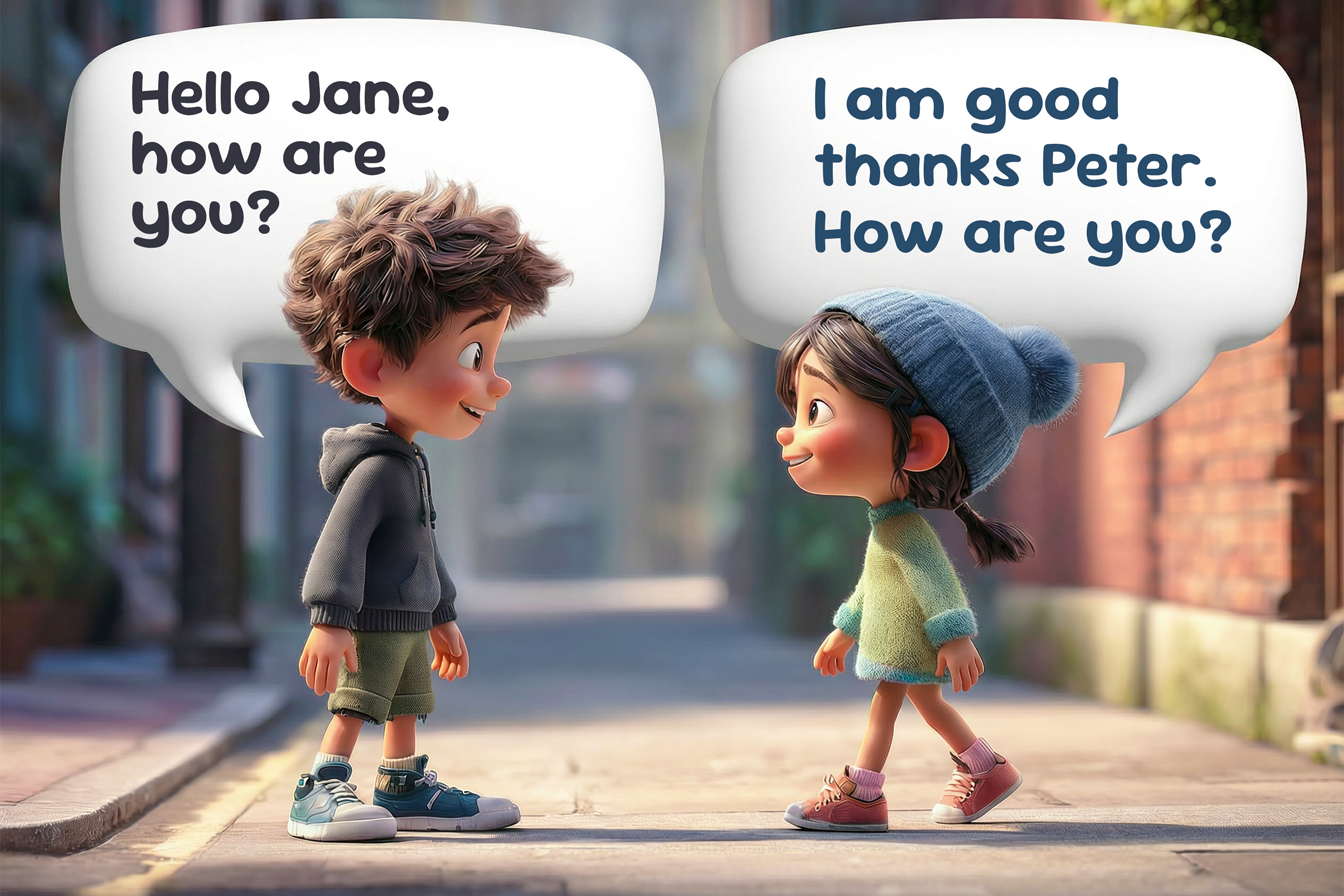
A picture of two children greeting each other as they walk past one another on a sidewalk. The speech bubbles indicate what they are saying. Something like: “Hello Jane, how are you?” “I am good thanks Mary. How are you?”
Across cognitive science and our own classroom research, the most effective learning strategies share common characteristics:
In short, the most effective study techniques are not passive. They are interactive, structured, and engaging.
If you are searching for the best study techniques to support your child’s English learning, focus on strategies grounded in research and classroom experience.
From active recall studying techniques like flashcards and guided questioning, to movement-based active learning techniques such as TPR, to structured phonics instruction and meaningful conversation practice, evidence consistency points to one conclusion: Learning lasts when children are actively involved.
At Novakid, we combine active learning strategies, movement-based teaching, phonics instruction, and communicative practice to help children build real, lasting confidence in English.
Book a FREE trial lesson today and discover how our expert teachers use the most effective study techniques to make learning, engaging, interactive, and fun!
Sources


Learn fun and interactive activities to teach English to preschoolers, including songs, games, crafts, and storytime, designed to make learning easy and enjoyable.
Upgrading your vocabulary helps you sound smarter and more confident. So here are better words for ‘very’ that can make your English stronger, clearer, and more fun!

By adding easy activities to a child’s routine - from labelling the house to cooking together, you can help them improve their language skills. Here are some ideas on what activities you can try at home.

Find out how Novakid matches students with teachers, the process for requesting a specific teacher, and why consistent instructors can boost your child’s English progress.
With AI-powered apps, chatbots, and smart tools, learners can get instant feedback, improve pronunciation, and practice conversations anytime. In this article we'll explore how AI is helping with learning English, the benefits and challenges of AI, and how to practice English with AI in a way that works for you.
In this article we explain how to test English proficiency in kids and what are the best ways to make the process of tests comfortable for young learners.
We and our partners use cookies and similar technologies to improve your experience, personalize content and ads, and analyze our traffic. By clicking ‘Accept all’ you agree that your personal data and cookies may be used for ad personalization, including sharing with Google. For more information, read our Privacy Policy and Google’s Privacy & Terms.
You can personalize your choices by clicking on ‘Cookie settings’.
Find more information about what cookies are and how we work with them in our Cookie policy and Privacy policy
Strictly necessary
Advertising
Analytics
Personalisation


