



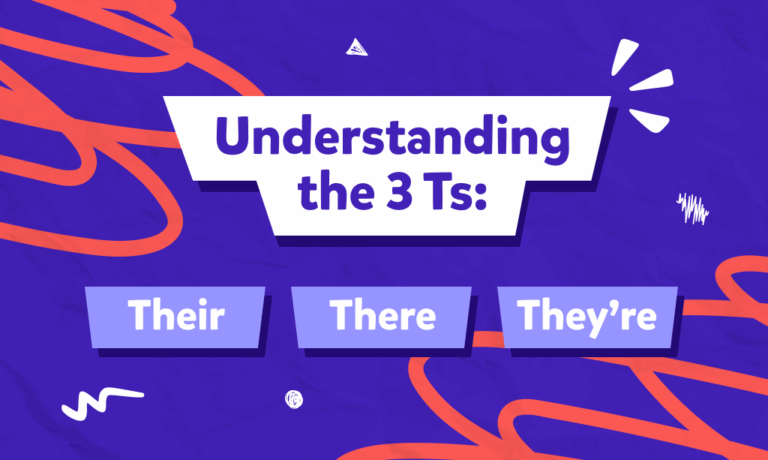
Master the distinctions between 'there,' 'their,' and 'they’re.’ Enhance your writing clarity and language by understanding when and how to use each term correctly.



Learning English can be tricky and overwhelming at first, especially when it comes to the many, often confusing, grammar rules in the English language. The good news is that you don’t need to learn everything at once to be able to start communicating in English.
By learning a few basic English grammar rules for beginners, you can start speaking and writing English with more confidence.
Here is a guide that breaks down simple English grammar into clear rules with easy explanations. Think of it as a “grammar for dummies” guide book, with practical grammar and examples that you can start using right away.
One of the most important grammatical rules in English is that every sentence must have structure to make sense. The most common structure is:
Subject (who or what) + verb (the action) + object (the person/thing doing the action)
For example:
Proper sentence structure ensures that speaking and writing are clear and easy to understand.
Understanding when to use capitalisation helps beginners write clear and correct English sentences. Capital letters are always used:
Full stops (periods), question marks, or exclamation marks, are always used at the end of the sentences.
For example:

Articles are words that we use to show whether a noun (something you can see and touch) is specific, or general.
Use “a” before nouns that start with consonants:
Use “an” before nouns that start with vowel sounds (a,e,i,o,u):
Use “the” when talking about a specific person, place, or thing:
Understanding articles is essential for simple basic English grammar.
Speaking in the correct tense helps the listener understand when an action happens. English has many verb tenses, but beginners should start by learning the present simple and past simple tenses, as these are the most commonly used in everyday conversation.
Correct verb tense usage improves overall grammar usage in both speaking and writing.

One important part of English grammar rules and pronunciation is understanding silent letters. Silent letters are letters that are written but not pronounced when speaking. This can be really confusing for beginners, so learning how to pronounce some common words with silent letters can be helpful.
For example:
For a more detailed explanation, read our full guide on the silent English rules.
To talk about more than one thing, add ‘-s’ or ‘-es’ ending to the noun.
For example:
However, it is important to memorise the plural nouns that are irregular, such as:
In English, the adjective (describing word) usually comes before the noun.
For example:
In English, some words sound the same but have different spellings and meanings. These words are called homophones, and they can be especially confusing for beginners. Understanding them helps learners improve both reading and grammar usage. Some common homophones include:
Learning these common homophones helps learners avoid mistakes in writing.
Questions in English often use a different word order than statements.
For example:
Understanding question structure is an important part of English grammar rules for beginners.
When talking about the past in English, the regular rule is to and ‘-ed’ ending to the verb. However some verbs are irregular and change completely when used in the simple past tense. Learning the most common irregular past tense verbs is an important part of basic English grammar rules for beginners.
Some common examples include:
Understanding irregular past tense verbs helps improve grammar usage and makes speaking about past events clearer and more accurate.
Understanding basic English grammar rules for beginners helps learners:
Once these foundations are strong, learning more advanced grammar becomes much easier. Once you have mastered these basic rules you can move onto some more challenging ones.
Learning English grammar doesn’t have to be stressful or confusing. With the right guidance, supportive teachers, and engaging lessons, children can build strong grammar foundations step by step.
At Novakid, our experienced ESL teachers use interactive lessons, clear explanations, and age-appropriate methods to help children master basic English grammar in a fun and motivating way.
Book a FREE trial lesson today and see how Novakid can support your child’s English learning journey.


Master the distinctions between 'there,' 'their,' and 'they’re.’ Enhance your writing clarity and language by understanding when and how to use each term correctly.

In this article we explain how to improve listening skills for ESL learners and provide seven tips on how to do that.

With AI-powered apps, chatbots, and smart tools, learners can get instant feedback, improve pronunciation, and practice conversations anytime. In this article we'll explore how AI is helping with learning English, the benefits and challenges of AI, and how to practice English with AI in a way that works for you.

Learn how mindfulness can help ESL students reduce language anxiety with easy mindfulness activities for kids, teens, and adults to improve enjoyment while learning English.

Grammar might sound complicated at first, but it’s really just the rules that help us put words together correctly. The more you practice, the easier it gets. Here are some exercises to help you.

In this article a Novakid teacher shares some practical tips and strategis on how to get ready for the ESL exams.
We and our partners use cookies and similar technologies to improve your experience, personalize content and ads, and analyze our traffic. By clicking ‘Accept all’ you agree that your personal data and cookies may be used for ad personalization, including sharing with Google. For more information, read our Privacy Policy and Google’s Privacy & Terms.
You can personalize your choices by clicking on ‘Cookie settings’.
Find more information about what cookies are and how we work with them in our Cookie policy and Privacy policy
Strictly necessary
Advertising
Analytics
Personalisation


